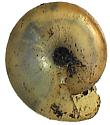
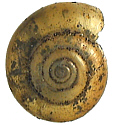
Gloss SnailsOxychilidae Hesse, 1927 (1879) |
| Diese Seite auf Deutsch! |

|
|
|
|||||
| Gloss Snails (Zonitidae etc.) | Dagger Snails (Gastrodontidae) | Gloss Snails (Oxychilidae) | Daudebardias (Daudebardiinae) |
|---|---|---|---|
|
|
|
|
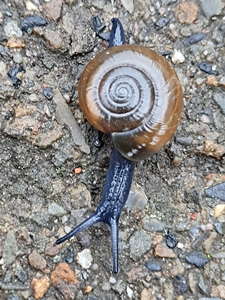 Oxychilus draparnaudi: Hannover, Germany. Photo: André Apel (iNaturalist). |
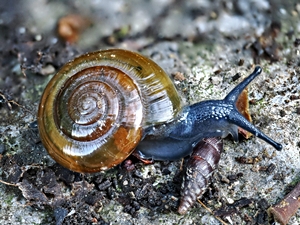 Plaited Gloss Snail (Morlina glabra): Namur, Belgium. Photo: Gilles San Martin (iNaturalist). |
Many species are predators of earthworms and other smaller snail species, as well as carrion eaters.
The Oxychilidae family has a palaearctic pattern of distribution ( see Faunal
Provinces), only Oxychilus profundus Neubert
1998 is also present on the Ariabian Peninsula. However, e.g.
Oxychilus cellarius and
Oxychilus alliarius have also been introduced by
man to Australia.
see Faunal
Provinces), only Oxychilus profundus Neubert
1998 is also present on the Ariabian Peninsula. However, e.g.
Oxychilus cellarius and
Oxychilus alliarius have also been introduced by
man to Australia.
The Oxychilidae family is divided into three subfamilies, according to MolluscaBase: Apart from the Oxychilinae those are the Daudebardiinae (see above) and the Selenochlamydinae, of which one species is the Welsh Ghost Slug (Selenochlamys ysbryda).
The first description of the then subfamily Oxychilinae was by Hesse (1879), as quoted by Geyer, D. (1927), "Unsere Land- und Süsswasser-Mollusken" (see below).
In the following text, mainly some domestic (i.e. Central European) species of the genus Oxychilus (Oxychilinae) are to be described. Part of this subfamily also are other genera, such as, for example, Morlina (picture left), which in earlier times was called Oxychilus as well.
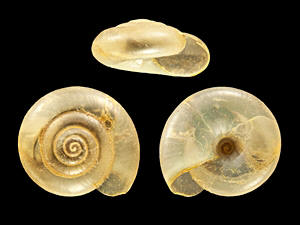 Shell of Oxychilus alliarius. Photo: H. Zell (Source). |
Large Gloss Snail - Oxychilus draparnaudi (Beck, 1837)
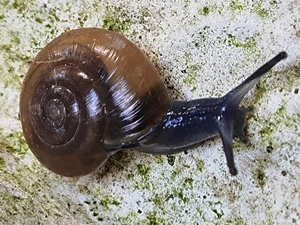 Large Gloss Snail (Oxychilus draparnaudi): A Coruña, Galicia, Spain. Photo: Pablo Torres Luaces (iNaturalist). |
The Large Gloss Snail is a predator, mainly of other smaller snails, but also feeds on fresh and wilted plant parts. Its main prey are juvenile banded snails (Cepaea) up to a size of about 10 mm, as well as juvenile slugs. The shells are completely emptied, but remain completely intact.
Also when the snail feeds on slugs, the internal chalk plates are left completely gnawed clean. That means that the snail does not fill its calcium needs by grawing on the shells of its prey, but exclusive by feeding on their flesh.
Frömming,
E. (1954): Biologie der mitteleuropäischen Landgastropoden. Duncker & Humblot,
Berlin, S. 89–97. (In German).
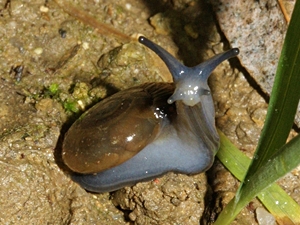 Oxychilus draparnaudi: Oak Creek, Agoura Hills, Kalifornien, USA. Bild: James Bailey (iNaturalist). |
Mahlfeld,
K. (2000): "Impact of introduced gastropods on molluscan communities, northern
North Island". Wellington. (PDF).
Dimensions: H: 6 - 7 mm; W: 12 - 14 mm; N: 5 - 5½.

Habitat and Distribution: The snails live in humid and sheltered places, under leaves and stones, in open and half open landscapes, as well as between rocks, originally in warm and humid deciduous forests. Today, in Central Europe it is mostly found introduced by man, especially in cultivated landscapes, such as gardens, parks, greenhouses and compost heaps, as well as along roadsides and in vegetable refuse deposits.
The distribution area of Oxychilus draparnaudi originally stretched from southwestern and southern Europe as far as southwestern Germany. Today, it has also been introduced to a large part of Central Europe, the British Isles and eben on other continents. In Scandinavia, the species has only been found in gardens and greenhouses. In Switzerland it has been found at altitudes of up to 2000 m MSL, but above 1000 m it becomes very rare.
Due to introduction by humans, the species also appears in other temperate regions of Earth.
Cellar Gloss Snail - Oxychilus cellarius (O. F. Müller 1774)
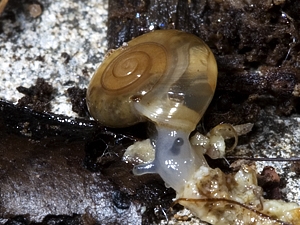 Cellar Gloss Snail (Oxychilus cellarius) in a cave. Photo: Andrew Lewington, Cave Life in Wales. |
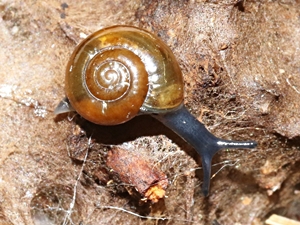 Oxychilus cellarius: Huon Valley, Tasmania, Australia. Photo: James Bailey (iNaturalist). |
Dimensions: H: 3 - 4; W: 10 - 12; N: 6.
Habitat and Distribution: Cellar Gloss Snails originally live in moderately humid decidual forests under leaves and dropwood, as well as between stone rubble. Like the name states, those snails often appear in cultivated landscapes. There, it is often found under brick rubble, decaying wood and in humid cellars. The German heathland poet and malacologist Hermann Löns, for example, at the beginning of the 20th century, has described Oxychilus cellarius from Westphalian coal cellars.
|
The species' distribution area originally spreads over western and central Europe, among this the British Isles including the Hebrides, the Orkney and Shetland Islands. In Norway, the Cellar Gloss Snail lives along the coast as far as north of the Polar Circle. In numerous other regions of the world, the snail was introduced as a culture follower.
Garlic Gloss Snail - Oxychilus alliarius (Miller 1822)
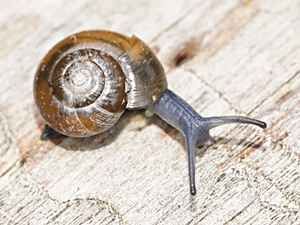 Garlic Gloss Snail (Oxychilus alliarius): Melbourne, Victoria, Australia. Photo: Reiner Richter (iNaturalist). |
In Germany, the Garlic Gloss Snail was selected as the mollusc of the year in 2014, especially due to the peculiarity of secreting a garlic smelling slime. As a carnivorous species, it regulates the populations of herbivorous snails and thus is an important factor in the exosystem, even in gardens.
Wiese,
V. (2014): Die Knoblauch-Glanzschnecke Oxychilus alliarius - Weichtier
des Jahres 2014. (PDF).
(In German).
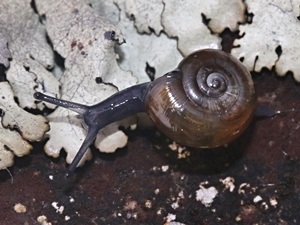 Oxychilus alliarius, juvenile: Hawaii, USA. Photo: James Bailey (iNaturalist). |
Habitat and Distribution: Predominantly the Garlic Gloss Snail is found in swampy habitats in deciduous forests on hillsides, in the moss, under leaves and stones. Besides, it is also found in humid habitats, such as stream valleys and riversides. In cultivated landscapes, it is also found on humid meadows, in gardens and greenhouses. In Switzerland, the Garlic Gloss Snail can be found in altitudes as high as 1300 m MSL.
The Garlic Gloss Snails mainly feeds on other snail species smaller than itself, small slugs (up to 10 mm length), but also on fresh plant parts and carrion.
The distribution area of Oxychilus alliarius originally spreads over northwest Europe as far as Iceland, southern Scandinavia, the British Isles and northern Germany. In a dispersed manner the species is also found in Switzerland, in the Austrian state of Vorarlberg, in Tuscany, Catalonia and on the Azore Islands. In many other regions, among others in North Amerca and Australia, it was introduced by humans.
Like many other Central European terrestrial pulmonate snails, the Garlic Gloss Snail up to today has been introduced in many regions of the world. For example, in Hawaii (picture on the right), Oxychilus alliarius has been discovered first in the 1930s. In the meantime, it has become the most frequent snail species there, threatening the domestic species and thus also the domestic bird species mainly feeding on those snail species. However, in the American conservation efforts, the problems caused for the endemic Partula snails by the introduction of the Rosy Wolf Snail (Euglandina rosea), so Oxychilus alliarius does not get the attention it deserves.
Curry,
P.A.; Yeung, N.W. (2013): "Predation on endemic
Hawaiian land snails by the invasive snail Oxychilus alliarius".
Biodiversity and Conservation, 22 (13–14): 3165–3169. (Abstract).
Swiss Gloss Snail - Oxychilus navarricus helveticus (Blum 1881)
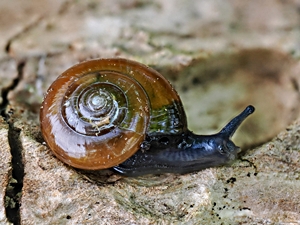 Swiss Gloss Snail (Oxychilus navarricus helveticus): Dinant, Belgum. Photo: Gilles San Martin (iNaturalist). |
Falkner,
G.; Ripken, T. E. J.; Falkner,
M. (2002): Mollusques continentaux de France. Liste de référence annotée et
bibliographie. - pp. [1-2], 1-350, [1-3]. Paris.
Description: The Swiss Gloss Snail has a thin walled shell with a horny yellow colour, with an almost round shape. At the navel (umbilicus), the colour changes into a more white shade. The suture between the whorls is only weakly visible. The navel (umbilicus) is not especially wide, only covering about an eighth of the shell diameter. In this, the species is different from Oxychilus alliarius, whose navel is relatively wider. Near the shell mouth of a living animal the characteristic black mantle seam is visible through the shell wall.
Dimensions: H: 4.5 - 6 mm; W: 7 - 13; N: 4½ - 6.
Habitat and Distribution: The Swiss Gllossy Snails lives in humid and shady habitats in forests and in between rock rubble. Mainly, the species is found under mosses in mountainous deciduous forests, where it prefers, ground rich in lmestone, more than Oxychilus alliarius. In Switzerland, the species is found at altitudes up to 1600 m MSL. Additionally, it is found in stream valleys, as well as nean springs, and like the Cellar Gloss Snail, also in caves.
In Great Britain, the Swiss Gloss Snail especially lives as a cultural follower. There, it is also found in quarries, at the roadside and in between refuse.
Smooth Gloss Snail - Morlina glabra (Rossmässler, 1835)
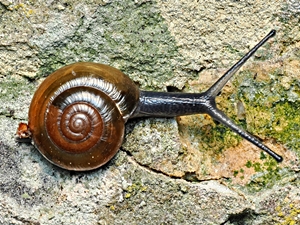 Smooth Gloss Snail (Morlina glabra): Namur, Belgium. Photo: Gilles San Martin (iNaturalist). |
The shell of Morlina glabra is thin and translucent, coloured reddish brown or brownish yellow, spotted white at the lower side. The upper side is very glossy and displays fine, smoothened radial wrinkles.
The snail's soft body is coloured dark blue grey. The upper tentacles are very long. A mantle flap covers the navel. The snail cleans the upper surface of the shell regularly.
Morlina glabra feeds on fresh and wilted plant parts, but also on living and dead animals. It actively hunts smaller snails, such as amber snails (Succinea) and Helicid snails (Cepaea and Arianta), however, of the latter two species it only eats juveniles. Doing so, it approaches the prey from behind or from the side. The prey generally reacts by withdrawing into its shell and secreting slime. Hiwever, this does not prevent the Gloss Snail from entering through the aperture and eating the snail alive.
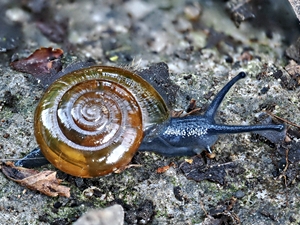 Smooth Gloss Snail (Morlina glabra): Namur, Belgium. Photo: Gilles San Martin (iNaturalist). |
Dimension: W: 12 - 18 mm; H: 5.5 - 9 mm; N: 5 bis 5½.
Habitat and Distribution: The species' distribution area reaches from central Spain over Catalonia, southern France and the Alps as far as the Carpathians, the Balkan and Greece and the European part of Turkey. Isolated occurrences also are in northwestern Spain and Portugal, on Gotland Island (Sweden) and in southern Italy (Basilicata, Calabria and Sicily). In Germany, there are occurrences on the Upper Rhine, the Berchtensgaden Alps, the Frankish Jura, the Thüringen Woods and in southern Saxony (Erzgebirge mountains).
The Smooth Gloss Snail prefers humid habitats in the leaf litter of forests, under mossy rocks and rock rubble on hillsides, as well as under deadwood in higher locations in low and high mountain ranges. In the Valais in Switzerland, Morlina glabra is found in altitudes as high as 1.850 m MSL, in Bulgaria as high as 1.900 m MSL.
Description,
ConchBooks).
 With Photos by Stefan Haller: http://www.schneckenfoto.ch. |
Latest Change: 27.07.2026 (Robert Nordsieck).