Dagger SnailsGastrodontidae Tryon, 1866 |
| Diese Seite auf Deutsch! |

|
|
|
| Diese Seite auf Deutsch! |
|
| Gloss Snails (Zonitidae etc.) | Dagger Snails (Gastrodontidae) | Gloss Snails (Oxychilidae) | Daudebardias (Daudebardiinae) |
|---|---|---|---|
|
|
|
|
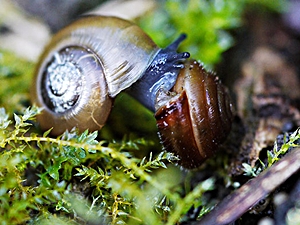 Gloss Snail (Aegopinella nitens) attacking a leaf snail (Peta- sina unidentata). Photo: © Stefan Haller, (schneckenfoto.ch). |
While those and similar genera in earlier times were counted among the Zonitidae family, today their systematical status is unclear to some degree, depending on which systematical source is consulted. MolluscaBase puts Aegopinella and other general in the family of the dagger snails (Gastrodontidae), a part of which, for example, is also the Zonitoides genus. V. Wiese, in the latest edition of his book "Die Landschnecken Deutschlands" ([The Land Snails of Germany]) follows this opinion, while the Naturportal Südwest, an internet page of the Stuttgart Natural History Museum, leaves Aegopinella and Retinella in the family Oxychilidae.
On the present page, the genera Aegopinella and Retinella therefore are placed in the dagger snail family, together with the Zonitoides genus.
Wide Mouthed Gloss Snail - Aegopinella nitens (Michaud 1831)
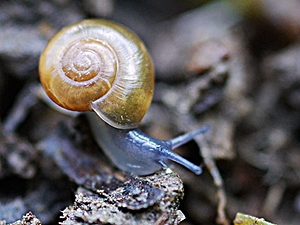 Wide-Mothed Gloss Snail (Aegopinella nitens). Photo: © Stefan Haller, (schneckenfoto.ch). |
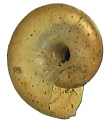 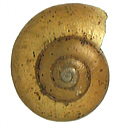 Wide-Mouthed Gloss Snail (Aegopinella ni- tens). Photo: Helmut Nisters |
In front of the aperture, the latest whorl noticeably widens (hence the name), so that it becomes almost three times as wide as the penultimate whorl. It is flattened and not descending at the aperture. The aperture itself only is a little oblique. The shell navel (umbilicus) is wide and shaped like a funnel.
Dimensions: H: 4 - 5.5 mm; W: 8 - 11 mm (in the Alps up to
14 mm); N: 4 - 4½.

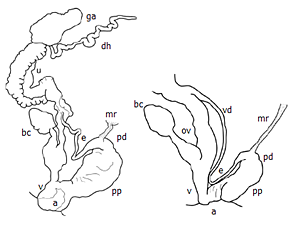
Habitat and Distribution: Wide-Mouthed Gloss Snails live in the leaf litter and beloe stomes in humid forests, as well in the valleys as on the mountain side. Aegopinella nitens prefers ground rich in limestone, especially in submontane and montane higher locations. Also, Aegopinella nitens is a hygrophilous species fond of humidity, which in Switzerland avoids sonny climates like in the Lower Valais and the Engadin.
The Wide-Mothed Gloss Snail is present in the Alps, the western Carpathians, and the low mountain ranges of Germany and Czechia. The northernmost finding location is near Bad Pyrmont in southern Lower Saxony. In the Alps, Aegopinella nitens is found in altitudes of up to 2300 m MSL, but rarely occurs above 1500 m MSL.
 |
Threat Situation: In Lower Saxony, the Wide-Mothed Gloss
Snail is considered as critically endangered ( see IUCN Threat
Categories).
see IUCN Threat
Categories).
Reddish Gloss Snail - Aegopinella nitidula (Draparnaud 1805)
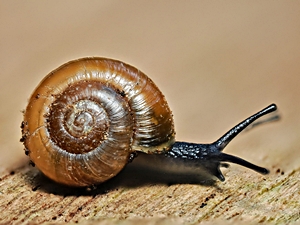 Reddish Gloss Snail (Aegopinella nitidula): Embourg, Chaud- fontaine, Belgien. Photo: Gilles San Martin. (iNaturalist). |
Dimensions: H: 4 - 6 mm; W: 6 - 11; N: 3.5 - 4.5.
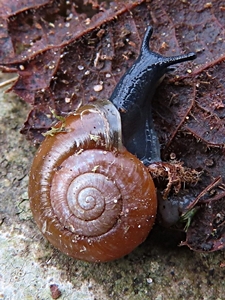 Reddish Gloss Snail (Aegopinella nitidula): Garrigill Garden, Cumbria, England, GB. Photo: Alex Playford (iNaturalist). |
It mainly feeds on decaying plant matter, but also partly is a predator: It hunts smaller snails (up to a diameter of 4.5 mm) and slugs (up to a length of 17 mm). It also likes to feed on earthworms and other kinds of worms.
The species' distribution area spread from the Azores over northern Spain, the British Isles and France as far a northern Germany, northern Poland and the South of Scandinavia. South of the North German Plain, the species occurs as far as Upper Swabia, northern Bavaria and Bohemia in a dispersed manner.
In North America, the species has been introduced by man, for example in British Columbia (Canada).
Lesser Gloss Snail - Aegopinella pura (Alder 1830)
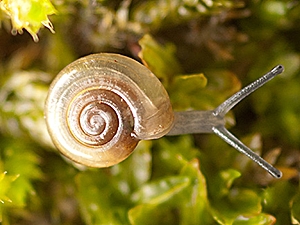 Lesser Gloss Snail (Aegopinella pura). Photo: © Stefan Haller, (schneckenfoto.ch). |
Dimensions: B: 3.5 - 5.0 mm; H: 2.0 - 2.7 mm; N: 3¾ - 4¼.
Habitats and Distribution: The Lesser Gloss Snail lives in the leaf litter. It is found around plants and under deadwood in moderately dry forests on mountains and in plains, especially on ground rich in limestone. Mating takes place in spring, the adult snails die after laying eggs. The juveniles mature after two years.
Schwer,
H. (1994). Populationsbiologie kleiner laubstreubewohnender Landgastopoden:
Lebenszyklus und saisonale Abundanzdynamik am Beispiel von
Aegopinella pura (Alder 1830). - Mitt.
Dt. Mal. Ges. 54: 13-14.
The distribution area of the Lesser Gloss Snail spreads from Iceland over Central Europe as far as northern Iran; in Scandinavia it is mainly found at the coast. Aegopinella pura is present in mainland Italy and Sardinia, but absent in Sicily. It is also absent in southern Turkey. In the entire Alpine region, it is present, including the foothill regions, as well as in the Carpathians and their eastern spurs and foothills. In Switzerland, the Lesser Gloss Snail is found in altitudes up to 2300 m MSL.
South-Alpine Gloss Snail - Retinella hiulca (Albers 1850)
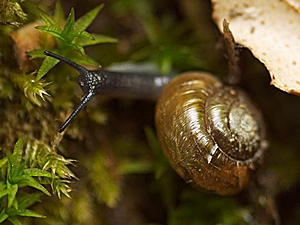 Südalpen-Glanzschnecke (Retinella hiulca). Bild: © Stefan Haller, (schneckenfoto.ch). |
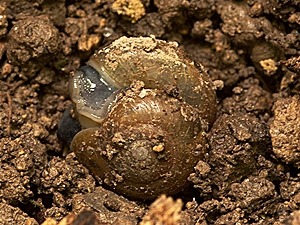 South-Alpine Gloss Snails (Retinella hiulca) mating. Photo: © Stefan Haller, (schneckenfoto.ch). |
The snail resembles Aegopinella ressmanni, a larger species of Aegopinella, but it is even larger. The shell is glossy and does not display clear growth lines, as little as the netted sculpture that is found in the Lesser Gloss Snail (Aegopinella pura) findet.
Dimensions: W: 10 - 14 mm; H: 6 - 7 mm; N: 4 - 4½.
Habitat and Distribution: Retinella hiulca also is an inhabitant of the leaf litter layer. The species is present on ground rich in limestone, in forests, on shady hillsides with bush vegetation, vineyards in between stones, as well as under stones in the vegetation in the waterside area of streams. Contrary to Aegopinella pura, Retinella hiulca only lives in altitudes of up to 1100 m MSL.
Like the name says, the distribution area of the South-Alpine Gloss Snail stretches over the Swiss Southern Alps (Southern Ticino, almost exclusively in the Sottoceneri region; findings in the Sopraceneri most likely are due to introduction by humans) and northern Italy (Lago Maggiore as far as Lake Como and the southern rim of the Lombard Alps).
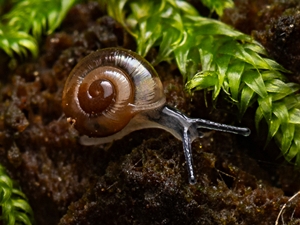 Quick Gloss Snail (Zonitoides arboreus): Ontario, Canada. Photo: Andrew Jackson (iNaturalist). |
Most dagger snails with a holarctiv distribution pattern (see Faunal Provinces), are small snail between several millimetres and about a centimetre in size. In North America, several species are present, as are in Central America, the Canary Islands and on Madeira. In Europe, there are three domestic species known, as is one greenhouse species: Zonitoides arboreus (Photo on the right). The snails usually live near water.
Black Gloss Snail - Zonitoides nitidus (O. F. Müller 1774)
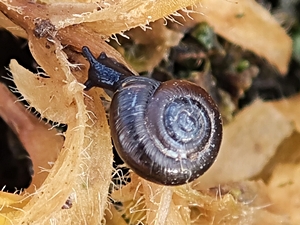 Black Gloss Snail (Zonitoides nitidus): Gmunden, Upper Austria. Photo: Jindřich Soukup/a> (iNaturalist). |
Dimensions: H: 3.5 - 4 mm; W: 6 - 7 mm; N: 4¾ - 5.
 Black Gloss Snail (Zonitoides nitidus) from the Canton St. Gal- len (Switzerland). Photo: © Stefan Haller (schneckenfoto.ch). |
The Black Gloss Snail is distributed holarctically and found in almost all of Europe, with the exception of the deep South. The species is rare in northern Greece and the Scottish and North English Highlands. It is, however, absent in northern Scotland, as well as the nearby islands. The species was introduced on the island of Menorca.
Threat Situation: In some parts of Great Britain, the Black Gloss Snail is declining because of the draining of its habitats
Quick Gloss Snail - Zonitoides arboreus (Say 1816)
 Quick Gloss Snail (Zonitoides arboreus) from Iowa, USA. Photo: Harlan Ratcliff. |
Dimensions: H: 1.7 - 3 mm; W: 4.5 - 6 mm; N: 4 - 4½.
 Quick Gloss Snail (Zonitoides arboreus) from Iowa, USA. Photo: Harlan Ratcliff. |
In North America, the Quick Gloss Snail is widely distributed: In Canada, it is found from British Columbia in the West as far as Newfoundland in the East, through the USA as far as Mexico and in the South as far as Costa Rica.
In Europe, however, the Quick Gloss Snail is a so-called greenhouse species, usually introduced with imported plants and found near the greenhouses. Especially on orchid plants, the snails are often found and can harm those with not insignificant amounts of feeding damage. The species is known as an introduced species from Iceland and Sweden, Austria and Hungary, Germany and Switzerland, as well as other parts of the world, such as Australia, Kamchatka, Japan, Hawaii, Israel and South Africa.
Escaped specimens sometime also can survive in the wild quite well. Wild living populations in Europe, however, are not well researched. According to more recent reports,wild living populations are known from Sweden (1956, 2003), Hungary (2001), Mecklenburg-Vorpommern in northeastern Germany (2003) and Czechia (2007). Older reports from before 1920 mention Finland, Russia and Ireland.
 With Photos by Stefan Haller: http://www.schneckenfoto.ch. |
Latest Change: 26.07.2026 (Robert Nordsieck).