DaudebardiasDaudebardiinae Kobelt 1906 |
| Diese Seite auf Deutsch! |

|
|
|
|||||
| Gloss Snails (Zonitidae etc.) | Dagger Snails (Gastrodontidae) | Gloss Snails (Oxychilidae) | Daudebardias (Daudebardiinae) |
|---|---|---|---|
|
|
|
|
 Rötliche Daudebardie (Daudebardia rufa): Bangor, Wales, Großbritannien. Bild: Yolanda Evans (iNaturalist). |
In mountain and hill country, where they usually live near springs in humid locations, they look for food under leaves and in rock rubble.
The systematic expression Daudebardia ist derived from the name of the French naturalist und malacologist André Étienne d'Audebard de Férussac (1786 - 1836), after whom also the Ground Snail (Ferussaciidae) have been named.
Stylommatophora
 Suborder
Helicina
Suborder
Helicina
 Superfamily Gastrodontoidea
Family Oxychilidae
Subfamily Daudebardiinae Kobelt 1906
Source: MolluscaBase eds. (2025): Daudebardiinae Kobelt, 1906.
Reddish Daudebardia - Daudebardia rufa (Draparnaud 1805)
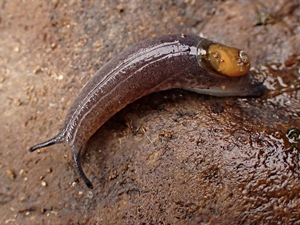 Reddish Daudebardia (Daudebardia rufa): Bangor, Wales, Great Britain. Photo: Yolanda Evans (iNaturalist). | |
 Reddish Daudebardia (Daudebardia rufa): Crete, Greece. Photo: Kaloust Paragamian (iNaturalist). |
 A daudebardia from the Vienna Woods with an unclear spe- cies designation. Photo: Martina Eleveld. |
Dimensions: H: 1.5 mm; W: 3.5 mm; L: 5 mm; N: 2½. Body
length: 17 - 20 mm.

Habitat and Distribution: The Reddish Daudebardia lives under leaves and stones in humid natural mountain forests, often in the vicinity of water. The mainly subterraneous species avoids decaying or swampy grounds, as well as acidic ground types. The Reddish Daudebardia feeds on earthworms, insect larvae and smaller snails, which are eaten whole.
The species' distribution area spreads over northern Algeria, Asia Minor and Europe. Daudebardia rufa is present from the Balkan Peninsula and Greece oevr the Carpathian foot hills, the Sudeten mountains and middle Germany as far as the Rhine Valley, also southern Italy, Sicily and Sardinia, as well as southern Anatolia and Cyprus. In Switzerland, the Reddish Daudebardia is found in altitudes of up to 1000 m MSL, in Bulgaria between 500 and 1500 m MSL.
Threat Situation: The Reddish Daudebardia in Europe is
rather rare and dispersed. Because of the little natural forests left not
disturbed by forestry, the Daudebardia only finds very few suitable habitats. In
Switzerland, Bavaria and the Austrian state of Vorarlberg, the species is
considered critically endangered, in the rest of Austria and Germany it is
considered endangered ( see IUCN Threat
Categories).
see IUCN Threat
Categories).
Description,
ConchBooks).
Latest Change:
26.07.2026 (Robert
Nordsieck).