
| Diese Seite auf Deutsch! |
|
Snails and Slugs – Terror of the Gardener? |
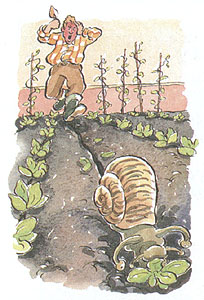 |
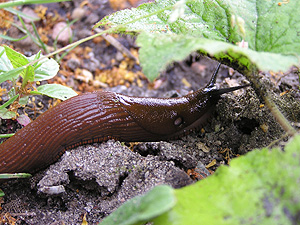 On light soles hungry slugs invade a gardener's green para- dise… [RN] |
One of the most annoying garden visitors certainly is the so-called Durham Slug or Lusitanian slug (Arion vulgaris). The vernacular name still derives from when the species was assumed to have migrated to Central Europe from Portugal (Lusitania) or Spain, hence also its former name Arion lusitanicus. Since then, however, it has been determined that the species much rather appers to be the result of mutation or hybridisation in Central European slug species, and has replaced the domestic species to a large extent due to a larger success in reproduction and likewise hybridisation, as well as a consequence of competition for food sources. Besides, it is much more mobile and less bound to specific habitats, while its numbers are so high it becomes a very notorious garden pest.
Of course, there are also other slug species, like the netted field slug (Deroceras reticulatum), the garden slug (Arion hortensis) and some snail species as well, that can reduce a lettuce bed's outcome to almost nothing.
What there is to do then? Most garden owners know no mercy and swing the chemical club. With all methods they try to overcome their slimy visitors, by hacking them in two with a spade, poison them with snail pellets, salt them or even coffee them – all very barbaric methods, come to think of it.
There are, however, differences between a regularly designed garden and a so-called bio-garden. Bio-gardens, like they appear today to an increasing degree. Remaining close to nature, bio-gardens allow living spaces or habitats to a much larger variety of plants and animals. And the amazing result is: Leaving nature its way, many problems are (almost) solved by themselves.
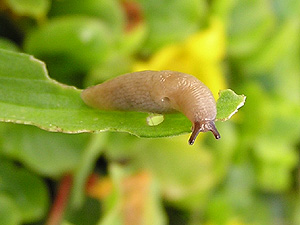 A real garden pest, but a small one: Deroceras agreste, the common field slug slug. [RN] |
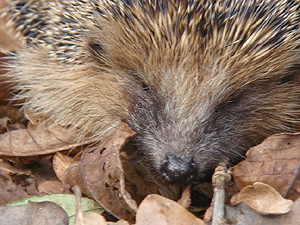 The European hedgehog (Erinaceus europaeus) also eats all sorts of slugs and so is a valuable ally, provided the garden leaves it room to live. Picture: Claudia Hahler. |
The problem is: Most cultural landscapes stop nature from regulating itself. This is why vermin invade, against which agriculture has to produce an arsenal of chemical weapons. Or does it not?
Luckily there are some ecologically feasible methods of limiting the slug problem. Poisoning one's garden is not among them. Poison is unselective. It poisons the prey as well as the hunter (including, by the way, the gardener, thinking of it).
To fight against snails and slugs, there is once again Sun Tzu's old saying "Know thine enemy!". Slugs usually have got a resting place in a protected position, from where they migrate to their feeding grounds in the evening. That means, the goal is to stop them from doing so by barring the way. That is done best by building a fence or wall the top edge bent, best made of metal, which gastropods do not like to crawl over. Note that a fence from wire mesh is good to stop snails, but slug will be able to squeeze through; that is one of the reasons that they became slugs in the first place! Also it is wise not to have plant parts hanging over the fence, so the slugs can climb over them – they will!
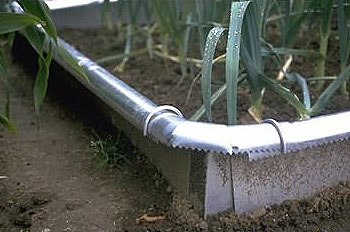 Snail fence: The bent edge is thought to make it even more difficult for slugs to climb the fence. Picture: Thomas Lohrer. |
Concerning working the earth, hacking in autumn is out. The freshly dug out earth makes it even easier for snails to lay their eggs. Hack in the spring, and you will also destroy at least some egg clusters.
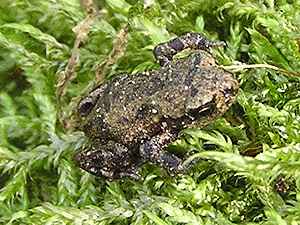 Common toad (Bufo bufo), a juvenile shortly after metamor- phosis. [RN] |
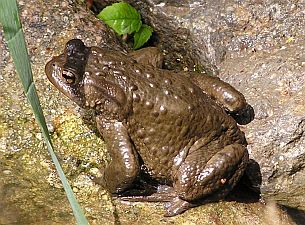 Adult common toad (Bufo bufo). [RN] |
Gardens left to nature not only are a resort for toads, blindworms, hedgehogs and moles, so that the gardener has valuable allies against slugs. But on one hand there will be arguments with the neighbours because of the mole hills in their gardens, and on the other hand those animals are so rare today, one will possibly not find them in their garden anyway.
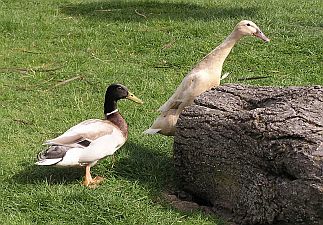 Indian runner ducks. Even the young love to eat snails and slugs, even the large slugs are not a problem, if there is a sufficient water source to get rid of the slime. [RN] |
There has been an ecology price for the "Rent an Ent" idea. Though the English is terrible and reminds of "Lord of the Rings", it essentially means "Rent a duck" ("Ente" in German means "duck"). Some running ducks – a domesticated version of the Indian penguin duck – can keep the garden free of snails. Renting the ducks to other gardens may even produce a little profit.
In addition to those measures there are about as many ideas how to get rid of slugs, as there are gardeners. One will say chamomile would keep the slugs away, whereas the next swears, chamomile would even attract them. That means, everybody has to try their own experiments.
The discovery that mosses (Bryophyta) and liverworts (Marchantiophyta) possess very efficient repellent agents against slugs, makes it largely unnecessary for gardeners to distribute poison. The Bonn professor Jan Peter Frahm discovered that mosses contain secondary plant agents, which repel slugs, but do not kill them. He examined two species, a moss (Neckera crispa) and a liverwort (Porella obtusata). In an alcoholic solution, both had strongly repellent properties against slugs, the liverwort about ten times as efficient as the moss. Distinct feeding repellence against the Lusitanian Slug (Arion vulgaris) could be determined even in a solution of 0.25%.
Moss extract to be applied in the garden in the meantime is commercially available.
In summary I would like to hope the reader to have understood that it is not necessary to poison the environment to get rid of slugs. A garden in accord with nature is much less susceptible to slugs, than an artificial ruler garden. Besides, it is much more beautiful to look at.
Latest Change:
12.07.2026 (Robert
Nordsieck).
Latest Link Check: 24.05.2026.
