Enemies of Terrestrial Snails
|
| Diese Seite auf Deutsch! |

|
|
|
Animals that eat snails can be found in almost every systematic group. Snails usually are quite defenceless and so are welcome sources of protein to many animals. Even those that usually do not eat snails will do so in times of meagre food supply. That is also true for man: It seems hard to imagine that, while snails today are an expensive delicacy for few, during the Thirty Years' War farmers ate snails, because they had nothing else to eat.
 |
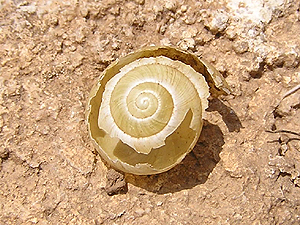 A White-lipped Snail's shell, opened by a carabid's mandibles following the shell whorls. Picture: [RN] |
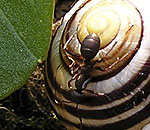
Against larger insects, this mucus defence does not help. Especially carnivorous beetles, such as ground beetles (Carabidae) and fireflies (Lampyridae) (among the latter especially the larvae) are used to attacking and eating snails.
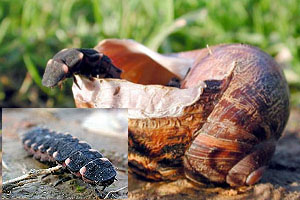 Picture: François Panchout. Source: Le monde des insectes. |
The picture on the right shows a firefly larva (Lampyris noctiluca) that has killed a Brown Garden Snail (Cornu aspersum) and is about finished eating it. Of course, it is much easier to kill a banded snail (Cepaea), whose bands and colours will not help it against an insect.
 Insectes et
"escargots" : Insectes malacophages et hélicophiles.
Insectes et
"escargots" : Insectes malacophages et hélicophiles.
Marsh flies (Sciomyzidae) are associated with snails and mussels, which they parasite or prey upon. While most species live in the water and attack pond snails (Lymnaeidae) and pea mussels (Pisidium), there are also numerous terrestrial species living predominantly in forest habitats and feeding on terrestrial snails, such as Cochlicopa, Aegopinella and Discus.
Bugguide.net: Marsh
flies or Snail killing flies (Sciomyzidae).
Not only insects eat snails, also many arachnids: Among the harvestmen (Opiliones) there are species (Ischyropsalis hellwigi) that almost exclusively live on snails.
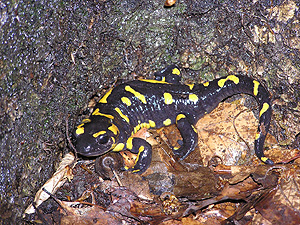 Fire Salamander (Salamandra salamandra), a female. [RN] Note the snail below the salamander's head! |
|
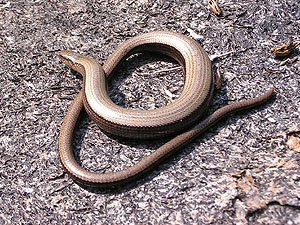 Blindworm (Anguis fragilis). [RN] |
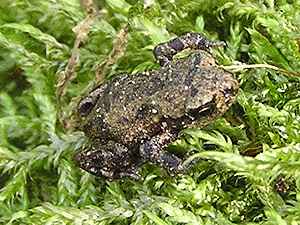 Common Toad (Bufo bufo), a juvenile shortly after metamor- phosis. [RN] |
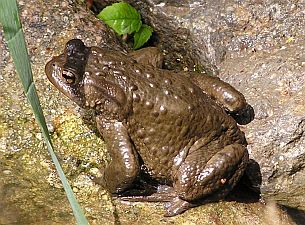 Adult Common Toad (Bufo bufo). [RN] |
Among reptiles, mainly small non venomous species also eat snails, for example the European Blindworm (Anguis fragilis) and the Australian Snail Skink (Tiliqua gerrardii), a small lizard. Among snakes there are for example certain canopy snakes from Costa Rica. Songbirds usually also eat snails, if their size allows them to do so. The Song Thrush (Turdus merula) has solved the problem how to crush a snail's shell by throwing them on a suitable hard stone. Usually it uses the same stone ever and ever again, which is why there many broken snail shells can be found. Such a stone is then called a thrush anvil.
On the other hand, snails have adapted to this by a most uncommon form of camouflage – depending on vegetation cover and ground colour, banded snails can be yellow or red, banded or unbanded, always those camouflaged best are selected to survive. Next to song birds, also fowl and ducks (for example the so-called runner ducks) eat snails. Stork, heron and other birds also will not leave a tasty snail aside.
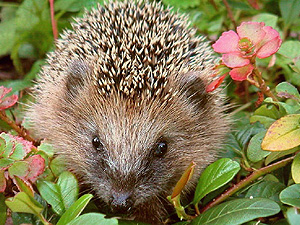 European Hedgehog (Erinaceus europaeus). Picture: Torsten Freitag. |
Of course, one enemy of snails remains to be named at last: Man. Not only are there many snail species that are picked and eaten since Stone Age times. There is also the increasing destruction of nature that has its effects on snails as well. Snails, such as door snails (Clausiliidae) usually remain in one place. That is why changes in their environment – destruction and pollution – affect them more than other animals. Only one of many examples is the extinction of endemic Partula tree snails on the Pacific islands of French Polynesia, such as Moorea. Besides being an example for human stupidity and narrowness of mind, it very well shows what happens to small scale ecosystems if foreign snail species are introduced.
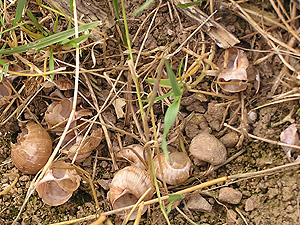 Shrews have bitten open the shells of these Roman snails (Helix pomatia) on a snail farm. [RN] |
Nevertheless, it still retains its vernacular name, though the species called Arion lusitanicus was found to still live in Portugal and to be a separate species. The Lusitanian Slug does slowly but continually replace the domestic slug species, such as Red and Black Slug (Arion rufus and ater) by hybridisation, predation and simply by being more successful in reproduction and competition for food sources.
Looking at the red lists it becomes obvious, that there are also very many snail species threatened by extinction. As well as their relatives, the mussels, fresh water snails, such as the Bladder Snail (Aplexa hypnorum) or the Fresh Water Limpet (Ancylus fluviatilis) are affected by pollution and destruction. On the other hand, species the the New Zealand Mud Snail (Potamopyrgus antipodarum) grow in number in European lakes and rivers, since they are far less susceptible to water pollution as are the domestic species.
These days, every school child knows threatened birds, such as the stork and it knows those animals slowly die out in our countries because of waters polluted and environment destroyed – rivers straightened and dug out.
But it should not be forgotten, that many snail and mussel species are among those animals. The Red List in the German federal state of Baden-Württemberg alone mentions 235 species of snails (204) and mussels (31) threatened by extinction, disproportionately many of which are fresh water species.
Latest Change:
26.07.2026 (Robert
Nordsieck).
Latest Link Check: 12.07.2026.