
| Diese Seite auf Deutsch |
|
Cephalopods in Myths and LegendsFormer Title: "20000 Leagues Under the Sea - The Legend of the Giant Octopus". |
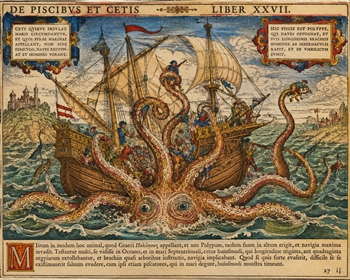 A kraken attacking a sailing ship, as envisioned by Olaus Magnus and Conrad Gesner. AI Illustration: Robert Nordsieck.  Enlarge Image!
 |
| Part 1 | Part 2 |
Part 3
 |
Part 4 |
|---|---|---|---|
Each legend, it is said, contains a grain of truth. As we know today, the Kraken legend contains more than just one grain. On the other hand, many ancient horror stories of multi-armed sea monsters dragging careless sailor into the ocean's deep also tend to contain a distinct measure of ignorance.
One thing is for sure: The sea with its unexplored depths, as close as it may be to us in matters of distance, somehow is farther from us than the solar system. Creatures from the deep sea usually only are known to us if they get caught in some fisherman's nets. Hardly ever are they caught alive, since they die upon reaching the surface, the same way we would die in the deep without technology's protection. And even if we can build bathyspheres today that enable us to go there, we, at the end of the day, know almost nothing.
So basically who are we to judge scholars from the Renaissance who had just been notified that there is a whole new continent in the west, that they either knew nor understood what lives in the deep? Because, as a matter of fact, neither do we.
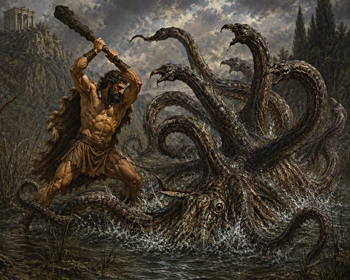 Heracles (Hercules) fighting against the Lernaean Hydra. AI Illustration: Robert Nordsieck.
Enlarge Image! |
If one sets aside the literary and mythical elements, the description bears a certain resemblance to an octopus: Like Scylla, an octopus might remain hidden within a rocky crevice and extend only its arms into the surrounding water in search of prey. Unlike Scylla, however, the octopuses inhabiting Homer’s native Greek waters rarely exceed a metre in length and are certainly far too small to threaten ships or their crews. Therefore, it is likely Scylla was not inspired by a single creature, but rather represented a combination of different dangers faced by ancient mariners.
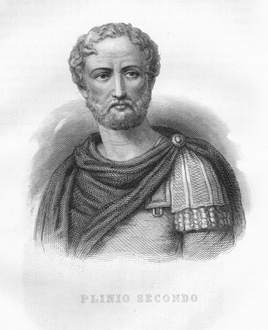 Gaius Plinius Secundus (Pliny the Elder), 23/24 - 79 BC. Picture: Cesare Cantù, 1859 (Source). |
Several centuries after Homer, Aristotle (384–322 BC) described the "Polypus". By the Greek term πολύπους (polýpous), meaning "many-footed", he was referring to the octopus. Today, however, octopuses are more commonly designated by another Greek-derived term, ὀκτώπους (oktṓpous), meaning "eight-footed". In 1742, the French naturalist René-Antoine Ferchault de Réaumur transferred the term "polyp" to the cnidarians (jellyfish and their relatives), and until today, it remains largely associated with that group of animals.
Some decades after the change of time, the "Naturalis Historia" of the Roman scholar Pliny the Elder (Gaius Plinius Secundus in Latin) was published posthumously in AD 79. Pliny himself had died during the eruption of Mount Vesuvius. In this work, adopting Aristotle's terminology, he described, among other things, a gigantic "polyp" that was reported to have raided fish ponds near the coastal town of Carteia, close to Algeciras in modern Spain. According to the account, the creature had arms ten metres in length and was eventually killed by the guards. Afterwards, it reportedly emitted an extraordinarily unpleasant smell.
To those who know cephalopods, this description reminds of a Giant Squid (Architeuthis dux). Giant Squids can certainly grow to that size and are also known to accumulate ammonium compounds within their tissues to support buoyancy. In some cases, modern researchers have likewise complained about the strong ammonious odour of a dead Giant Squid. Furthermore, stranded Giant Squids have been reported numerous times from the waters around the Iberian Peninsula, both in historical times and in the modern era.
The term Krake or Kraken has its roots in Scandinavia. The earliest known reference may come from the Örvar-Odds Saga. In this legendary Icelandic saga, written down in the late thirteenth century, the hero narrowly escapes a Kraken that threatens to devour both him and his ship.
Wikipedia (German):
Örvar-Odds Saga.
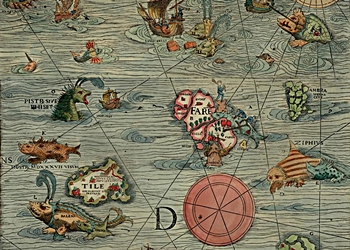 Carta Marina (1539), map section of the Faroe Islands. Picture: Olaus Magnus (Source).
Enlarge Image! |
|
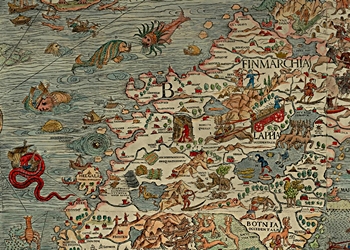 Carta Marina (1539), map section of the Norway coast. Picture: Olaus Magnus (Source).
Enlarge Image! |
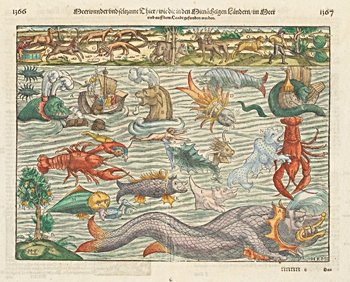 Meerwunder und seltzame Thier: Sebastian Münster, Cosmographia 1544 (Source).
Enlarge Image! |
View Page!), he described the Kraken as an enormous cephalopod. His account
was based on reports from Norwegian fishermen whom he had encountered during his
travels throughout Scandinavia. He wrote of monstrous sea creatures, terrible in
appearance and entirely black in colour, with a square head, long horn-like
appendages like roots of a tree, and a unmoving, cruel eye measuring a cubit
across and deep red in colour. It seems likely that, even if Olaus Magnus had
never personally seen such a creature, at least some of the fishermen who
described it to him had. His account gives the Kraken a circumference of ten
cubits and arms extending a further ten cubits.
Assuming that a cubit varied regionally between approximately 50 and 80 cm, the Kraken described by Olaus Magnus could have reached a total size of up to sixteen metres.
Olaus Magnus: "Historia
de Gentibus Septentrionalibus" (1555):
Project Runeberg.
Albers, Madelief, Nyholt, Sanna: "Olaus
Magnus' Monstrous Creatures". Digital Exhibition of the
University of Groningen Library, 2026.
The Carta Marina itself already illustrates one of the difficulties involved in interpreting such reports. Although intended as a detailed and accurate map for its time, it also served to warn sailors of potential dangers. The seafarers' accounts upon which Olaus Magnus relied may therefore have blended genuine observations with imagination and embellishment. It should also be remembered that he depicted not only legendary sea monsters but also many real animals, including whales, killer whales, walruses and seals.
Nevertheless, certain conclusions may still be drawn. Olaus Magnus clearly wished to combine natural history with the traditions and folklore of the Scandinavian peoples. The fact that he referred to the creature as a Kraken does not necessarily mean that it was an octopus (for example, in German, the word "Krake" literally means octopus). The dimensions he recorded would not be unreasonable for a Giant Squid (Architeuthis dux), especially if some allowance is made for sailors' exaggerations. Likewise, the reddish colouration is not entirely implausible in this context, since on one hand, Giant Squids have a reddish colour because that means the best camouflage in the deep sea. On the other, many cephalopods change their colour to a reddish hue if they are stressed or aggressive. Even in modern times, Giant Squids have occasionally been stranded along the coasts of the British Isles and elsewhere in the North Atlantic.
Henry Lee, in "Sea Fables Explained" (1883; see Literature), also suggested that the sea serpent described by Olaus Magnus (visible in red in the picture on the left) may in fact have been interpreted from the large tentacle of a Giant Squid. Here again, the reddish colouration might fit such an explanation. Shortly after the publication of his book, however, Lee was criticised by the Dutch zoologist Oudemans, who pointed out that Olaus Magnus had explicitly described a sea serpent. Lee nevertheless conceded that many reports of so-called "sea serpents" were probably based on observations of unusually large seals.
Sections of the Carta Marina, as well as the "Historia de Gentibus Septentrionalibus", were widely copied and cited by contemporaries of Olaus Magnus. One of them was the German cosmographer and polymath Sebastian Münster (1489 - 1552), who illustrated "marvels of the sea and strange beasts found in the northern lands and seas" in his famous Cosmographia of 1544.
Nigg, Joseph: "Olaus'
Magnus' Sea Serpent".
The Public Domain Review, 2014.
Wikipedia:
Cosmographia (Sebastian Münster).
 Conrad Gesner (1516 - 1565): Swiss naturalist. Picture: Jules Pizzetta (1895), (Source). |
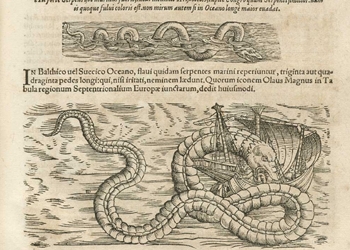 Sea serpent, after Olaus Magnus. Picture: Conrad Gesner (1558), Vol. 4, S. 93. (Source).
Enlarge Image! |
 |
|
Gesner, Conrad: Historia animalium liber IIII. qui est de piscium et aquatilium animantium natura. Christoph Froschauer, Zürich 1558 (Zentralbibliothek Zürich). |
Such reports must also be understood within the intellectual climate of the Renaissance. Scholars were gaining renewed access to classical literature, while the great voyages of discovery (Columbus had reached the Americas in 1492) continually revealed unfamiliar animals and plants previously unknown in Europe. The scholars of the early Renaissance had little means of determining whether a fisherman's report, even allowing for the proverbial tendency of sailors to exaggerate, represented a genuine observation or entirely belonged to the realm of imagination.
Reports of Krakens in Scandinavian waters did not cease after Olaus Magnus. If anything, they became even more extravagant. During the following centuries several Scandinavian naturalists described the Kraken, among them Hans Egede, the "Apostle of Greenland", in the early eighteenth century.
Egede was probably one of the first writers to popularise the Norwegian term Kraken. Particularly remarkable are his extraordinary size estimates and his claim that the creature had several heads and claws. This may sound less implausible considering that the Colossal Squid (Mesonychoteuthis hamiltoni) and the Humboldt Squid (Dosidicus gigas) possess hook-bearing tentacles, unlike the Giant Squid. Neither species, however, occurs naturally in Norwegian waters, so neither of them was known in Europe at the time.
Egede also recorded an encounter with a sea serpent (see also Henry Lee, 1885, p. 65). In his "Journal of the Mission to Greenland" he wrote:
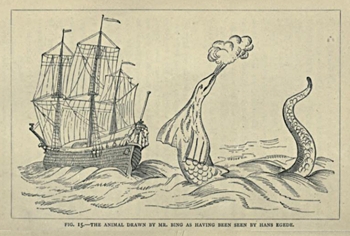 A picture of a sea serpent, as described by Egede in 1734. On the right: Lee's interpretation, what Egede might have seen. Source: Henry Lee (1883).
Enlarge Image! |
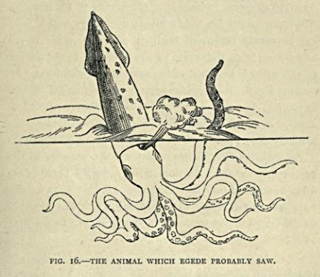 |
Henry Lee, who considered Hans Egede fundamentally honest and trustworthy, argued that he was trying to describe a creature he had never seen before and had observed only briefly. According to Lee, Egede was thus describing the impression the animal had on him rather than providing a precise zoological description.
Examining an illustration derived from Egede's account, which subsequently appeared in many later publications, Lee suggested more than a century later that the animal might actually have been a Giant Squid. Large squids are also often observed defending themselves against attackers by ejecting powerful jets of water through their siphon.
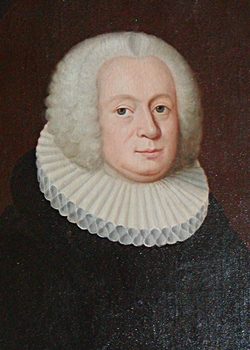 Erik Pontoppidan the Younger, first half of the 18. century. (Source). |
According to Norwegian fishermen, the Kraken usually inhabited depths of about eighty fathoms (approximately 150 metres). Its immense size was said to be so extraordinary that its back resembled a small island rising from the sea. Pontoppidan estimated its circumference at up to one and a half Norwegian miles, so when it surfaced, fishermen supposedly mistook it for an island. Its many arms or "horns" were said to be capable of wrapping themselves around ships and dragging them beneath the waves, "even the largest ships of war". At the same time, Pontoppidan attributed great importance to the creature for the local fishermen, since a large amount of fish was believed to gather around it. Experienced fishermen therefore deliberately sought out such locations. Among Norwegian fishermen there is even a saying: "You must have been fishing on the Kraken", meaning when an otherwise incompetent fisherman suddenly returned with an unusually large catch. Pontoppidan also reported that a young Kraken had once wandered into the bay at Ulvangen and died there. According to the account, it moved along the seabed "like a snail", using its arms to crawl.
Particularly notable is Pontoppidan's description of the creature disappearing: When the Kraken descended back into the depths of the sea, powerful currents and whirlpools supposedly formed, creating a danger to nearby ships. This reminds of older legends of whirlpools and sea monsters, such as those depicted by Olaus Magnus on the Carta Marina and, even more so, the classical story of Scylla and Charybdis from the Odyssey (see: Antiquity).
From a modern perspective, Pontoppidan's size estimates are deemed highly exaggerated. However, Pontoppidan himself interestingly criticised Olaus Magnus as "credulous" and dismissed some of his reports as "fables and inventions", but on the other hand, he also referred to Pliny's account of the Kraken in the "Naturalis Historia". Nevertheless, many scholars today suspect that his descriptions may have been based upon genuine observations of large cephalopods, perhaps Giant Squids, embellished by sailors' tales and centuries of oral tradition. His account of a young Kraken resembles a true octopus more closely, although no known octopus comes anywhere near the size he described. It is also possible that several different phenomena became combined in these stories: For example, a large floating mass of seaweed near the surface could explain the supposed island-like appearance and even the foul smell, while a Giant Squid could account for other aspects of the narrative. Furthermore, the floors of Norway's fjords carved by glaciers during the Ice Age are often extremely uneven, making sudden and dramatic changes in depth entirely possible.
Erik Pontoppidan: "Versuch
einer natürlichen Historie von Norwegen", German Edition of 1754 (Google
Books).
Real Stories DE:
Der Riesenkrake: Gibt es ihn wirklich? ( YouTube Video, German).
Wikipedia:
Kraken
(Mythology).
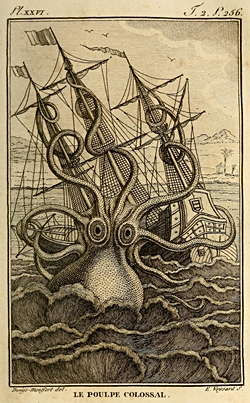 "Le Poulpe Colossal" by P.D. de Montfort, 1802, after a painting in St. Malo. (Source). |
Between 1801 and 1804, the French naturalist Pierre Dénys de Montfort (1766–1821) published his monumental work "Histoire naturelle, générale et particulière des mollusques, animaux sans vertèbres et à sang blanc" (General and Particular Natural History of Molluscs, Invertebrate and White-Blooded Animals). While the second volume was considered groundbreaking in the field of malacology, his contribution concerning the "Poulpe Colossal" or "Poulpe Kraken" ("Colossal Octopus" or "Kraken Octopus") proved highly controversial both among his contemporaries and later generations.
Montfort wrote with considerable scientific precision about several species of cuttlefish, squids and octopuses that are still recognised today, since he had been commissioned to revise the famous works of Buffon with regard to molluscs. At the end of his chapter on octopuses, beginning in Volume II, page 256, he introduced the subject of the giant polyp. He opened with the remarkable statement that "the facts I am about to present may appear so strange, indeed so unheard of, that many readers, despite their authenticity, will accept them only gradually, if at all." In retrospect, this proved a prophetic observation.
Montfort began his account of the "Poulpe Colossal" by describing an incident said to have occurred off the coast of Angola, where a vessel from Saint Malo was allegedly attacked by a gigantic octopus. According to the story, the sailors fought the creature with cutlasses and other weapons and eventually were able to escape unharmed. A painting commemorating the encounter was subsequently displayed in the Church of Saint Thomas in St. Malo. Montfort also referred to Pliny's account of the giant "polyp" from Carteia in Spain (see Antiquity). His conviction that such an animal must exist was encouraged by reports of ships disappearing under mysterious circumstances, which he believed had met a less fortunate fate than the formerly mentioned vessel from Saint Malo.
His contemporaries generally greeted these ideas with scepticism. After Montfort went so far as to suggest that an entire British fleet had been destroyed by a gigantic Kraken, he became the target of scientific criticism and widespread ridicule. Throughout much of the nineteenth century, he was therefore remembered primarily as an example of excessive speculation in natural history.
Modern assessments tend to be more nuanced. While Montfort's vision of giant octopuses capable of sinking large sailing vessels is clearly unrealistic in light of present knowledge, his basic assumption that gigantic cephalopods existed was not entirely wrong, as later discoveries would demonstrate. However, no octopus known today remotely approaches the dimensions he imagined. The largest known extant octopus, the Giant Pacific Octopus (Enteroctopus dofleini) from the Pacific coast of North America, may grow to an arm span of up to nine metres, while octopuses elsewhere in the world are generally much smaller.
What can reasonably be criticised, however, is that Montfort presented the animal explicitly as an octopus rather than a squid. Throughout his work he clearly distinguished octopuses from squids and cuttlefish. Although his fundamental idea of gigantic cephalopods would eventually prove correct, he made the mistake of presenting the giant octopus as a scientific reality rather than as an unproven hypothesis. This contrasts with many other cephalopods he described, which he had personally examined anatomically. Pierre Dénys de Montfort therefore provides a fascinating example of the early nineteenth century, a period in which scientific methods were beginning to emerge while myths and sailors' tales still exerted a powerful influence.
Wikipedia (Französisch):
Pierre Dénys de Montfort.
Pierre Dénys de
Montfort: "Allgemeine
und besondere Naturgeschichte der Weichwürmer (Mollusques)", Band 2, S. 153
ff. Ed. C. Ph. Funke, 1804,
Biodiversity
Library. Pierre
Dénys de Montfort: "Histoire
naturelle, générale et particulière des mollusques", Band II, S. 256 ff.
1802,
Biodiversity
Library.
In the decades after Montfort's work, giant cephalopods largely disappeared from public consciousness. Most naturalists regarded them as a creature that simply did not exist.

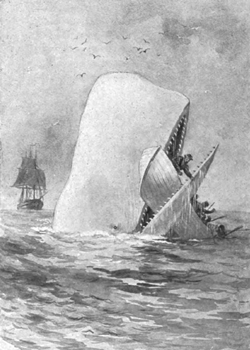 On the left: Herman Melville (1860), Photographer unknown. On the right: Picture from "Moby Dick" (1890). Picture: Augustus Burnham Shute. |
Melville particularly emphasised the Giant Squid as the principal prey of the Sperm Whale. He reported that dying sperm whales occasionally regurgitated torn tentacles measuring twenty or even thirty feet in length. According to this interpretation, the formidable teeth of the Sperm Whale had evolved precisely to attack and tear apart such gigantic prey.
To the sailors aboard the Pequod, however, the sighting of a Giant Squid remained an ominous sign. In the novel, the first mate Starbuck remarks that few whaling vessels that encounter this "white phantom" ever return safely to port. Since virtually no reliable scientific information existed at the time the novel was written, Melville also used the Giant Squid symbolically as an embodiment of the mysteries and dangers hidden in the unexplored depths beneath the waves of the ocean.
Lit2Go: Herman
Melville: "Moby
Dick", Chapter 59: "Squid".
Although a Giant Squid had stranded in Denmark in 1854, most of the specimen was cut up and used as fishing bait. Fortunately, part of its horny beak was preserved. Measuring more than 20 cm in length, it provided the Danish naturalist Japetus Steenstrup with enough material to describe the species as Architeuthis dux. Many researchers remained unconvinced all the same, because the available evidence was so fragmentary. A few years later, another Giant Squid stranded on the Shetland Islands, but the carcass was already badly decomposed. Only measurements could be taken: the shorter arms measured approximately 2.5 m and the long feeding tentacles about 5 m.
What did not happen at this stage was any serious attempt to connect these discoveries with the Kraken of myth and legend. The legendary Kraken was generally imagined as an octopus-like creature, or, in Pontoppidan's case, as an entirely mythical being.
That changed in 1861 when the French naval corvette Alecton returned to port with a remarkable report. In November of the previous year, near Tenerife, the crew had encountered a large creature floating at the surface. Its body was estimated at around 6 m in length, with tentacles perhaps even longer. The animal was brick-red in colour and possessed black eyes measuring 25–30 cm across. Capitaine Bouyer of the Alecton ordered the crew to fire upon the creature. Neither bullets nor harpoons appeared to have much effect until one shot apparently struck a vital organ, causing the animal to disgorge a foul-smelling mass from its stomach. The sailors managed to place a rope around the tail, but the rear portion tore away and the animal disappeared into the depths. The detached tail section, complete with its fins, was brought back to Tenerife. The French consul Berthelot subsequently forwarded measurements and an illustration to the Académie des Sciences in Paris. The body of the animal was estimated to have measured between 16 and 18 feet (approximately 5.3–6 m), excluding the tentacles.
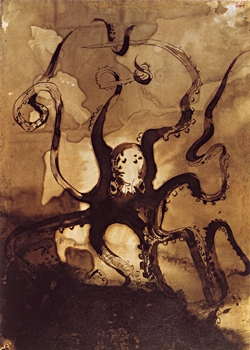
 On the left: The octopus from "Les Travailleurs de la Mer", Victor Hugo (1866). (Source). On the right: Victor Hugo, 1876, Photograph by Étienne Carjat. (Source). |
Hugo's Kraken is not intended as a zoological creature. Rather, it serves as a symbolic embodiment of terror: His descriptions are often nightmarish: the octopus is silent, intelligent, relentless, suffocating, and armed with powerful suckers. Hugo transforms it into something almost demonic, exaggerating every feature into the monstrous.
Wikipedia:
Victor Hugo,
Toilers of the Sea.
Wikipedia:
Joseph
Carlier:
Gilliat and the Octopus.
The report of the Alecton also reached the French author Jules Verne (1828 - 1905). When writing "Twenty Thousand Leagues Under the Seas" (1869), Verne incorporated the incident almost exactly into a conversation between Professor Aronnax, his assistant Conseil, and the Canadian harpooner Ned Land.
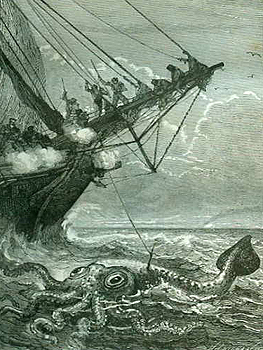
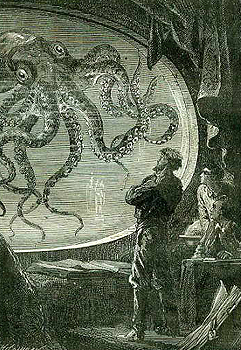 From Jules Verne's "20000 leagues under the seas". On the left: The Alecton's fight against a Giant Squid. On the right: Captain Nemo watching a giant octopus. Source: Andreas Fehrmann. |
Andreas Fehrmann:
Jules Vernes "Voyages
Extraordinaires" (German).
Wikipedia:
20.000 Leagues Under the Seas.
Professor Aronnax's investigation begins with a series of mysterious maritime accidents occurring across the world's oceans between 1866 and 1867. During his adventures he encounters the enigmatic Captain Nemo, who travels beneath the seas aboard the technologically revolutionary submarine Nautilus. Like many submarines that followed, the vessel was named after the Chambered Nautilus (Nautilus pompilius), a cephalopod whose buoyant shell represents one of nature's most sophisticated diving systems.
Throughout the novel, the protagonists experience numerous adventures, including a battle against numerous giant cephalopods. They are also present when Captain Nemo becomes the first human to reach the South Pole. This may seem perplexing today, but at the time it was not yet known that the South Pole is located above the continental landmass of Antarctica rather than in an open ocean. What Verne could not have imagined was that in 1958, a little more than fifty years after his death, an actual (albeit American) submarine called Nautilus would become the first vessel to travel to the North Pole - under the ice.
Like many of Verne's works, "Twenty Thousand Leagues Under the Seas" is both a celebration of the technological optimism of the Industrial Revolution and a cautionary tale: While it repeatedly portrays technology triumphing over nature, it also warns of the dangers that arise when great technical power is divorced from moral responsibility.
Neither Victor Hugo's novel nor Jules Verne's can, of course, be regarded as scientific papers. Nevertheless, both demonstrate how deeply the legend of the Kraken remained embedded in the cultural imagination. Even if the creature ultimately proved to be a Giant Squid rather than a gigantic octopus (see above), the idea persisted long after scientists had dismissed such stories as nonsense. To a certain extent this tension between folklore and science remains even today, although the discoveries to come would soon transform scientific views on giant cephalopods forever.
PBS Storied:
Release the Kraken! Origins of the Legendary Sea Monster. (
YouTube Video).
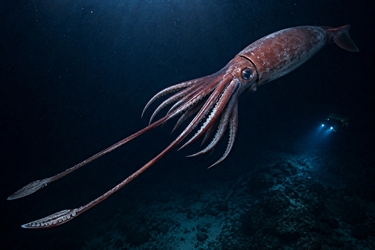 Giant Squid (Architeuthis dux): AI Illustration: Robert Nordsieck.
Enlarge Image! |
A few weeks later, however, Harvey had better luck. Fishermen discovered a somewhat smaller Giant Squid that had become entangled in their net. This time they managed to secure the entire animal, although they had to remove the head. Harvey obtained the specimen, and even a photograph was taken. The squid was carefully measured, and Professor Addison E. Verrill of Yale College, Connecticut, identified it, same as the earlier specimen, as Architeuthis dux (see Henry Lee, pp. 41 ff.).
Since then, numerous stranded Giant Squids have been documented around the world, one of the most recent being found in South Africa in 2022 (Link). Yet it was not until 2004 - 2005 that Kubodera et al. succeeded in taking the first photographs of a living Giant Squid in its natural environment.
 The author talking to Plinius, Conrad Gesner and Jules Verne. AI Illustration: Robert Nordsieck.
Enlarge Image! |
A third large squid species is the Humboldt Squid (Dosidicus gigas), which lives along the Pacific coast of Central and South America as far north as Baja California. Although it reaches a length of only about two metres, it is the only one of the three large squid species known to occasionally attack humans. Such incidents usually happen when the animals feel threatened, are provoked by the bright lights used by divers, are directly disturbed, or mistake a diver for prey.
In summary, although we know vastly more today than naturalists such as Olaus Magnus, Conrad Gesner or Erik Pontoppidan ever could, we are still far from understanding everything. Indeed, some of the stories and legends that were once dismissed as fantasy have, upon closer examination, turned out to contain at least a kernel of truth. When Henry Lee attempted to explain the legends of the Kraken and the Sea Serpent in 1883, he had only a handful of specimens and a wealth of anecdotal reports at his disposal. Today we know that several of his conclusions were surprisingly close to reality.
Even now, the ocean remains one of the last great frontiers of our planet. Despite all the technological advances available to modern science, vast regions of the deep sea remain largely unexplored. In many respects, these unknown depths are less well known to us than the Solar System.
And so there remain, even today, places in the depths of the sea that are truly "where no human has ever gone before".
YouTube Video, German).
YouTube Video).Latest Change:
11.07.2026 (Robert
Nordsieck).
Latest Link Check: 18.06.2026.
