Operculate Forest SnailsCochlostomatidae Kobelt, 1902 |
| Diese Seite auf Deutsch!! |

|
|
|
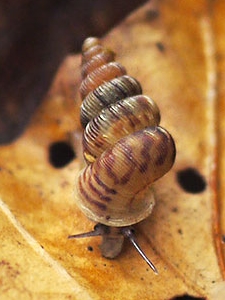 Cochlostoma septemspirale from Switzerland. Photo: © Stefan Haller, (schneckenfoto.ch). |
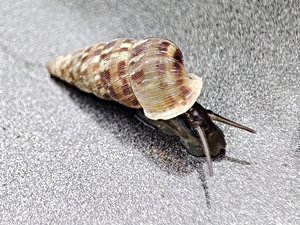 Obscurella obscura: Ariège, Midi-Pyrénées, France. Photo: Gaëtan Jouvenez (iNaturalist). |
This makes it probable that the ancestors of those snails have settled dry land over freshwater bodies, not directly from the sea. The ancestors of operculate land snails on the other hand, the closest relatives of which still are the periwinkles (Littorinidae), living in the sea. In the same way probably relatives of the coast snails (Ellobioidea) did, among whose terrestrial relatives are the terrestrial thorn snails (Carychiidae).
 How Did Snails Come to Live on Land?
Operculate forest snails have a highly coiled, acute shell with more or less
rounded whorls, a characteristically circular shell mouth (aperture) and a
wide apertural rim. The shell surface displays
pronounced ribs, whose form and density can be taken into account for
identification purposes in the same way as in
door snails (Clausiliidae).
Operculate forest snails have separate sexes, contrary to being hermaphrodites,
and so do the operculate land snails.
Gastropoda
 Subclass: Orthogastropoda
 Superorder: Caenogastropoda
Order: Architaenioglossa
Superfamily: Cyclophoroidea
Family: Cochlostomatidae Kobelt, 1902
Source:
MolluscaBase eds.
(2025):
Cochlostomatidae Kobelt, 1902.
Taxonomy of
Gastropoda:Clade Caenogastropoda: Cochlostomatidae.
Source: Wolfgang Fischer et al.: Checklist of Austrian Mollusca.
Lesser Operculate Forest Snail - Cochlostoma septemspirale (Razoumowsky, 1789)
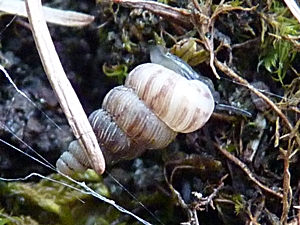 Lesser Operculate Forest Snail (Cochlostoma septemspirale), from the Salzkammergut in Austria. Photo: Martina Eleveld. |
|
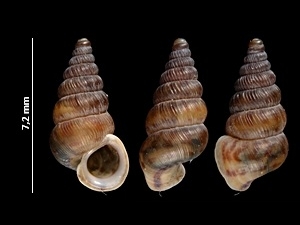 Cochlostoma septemspirale: Ardèche, Rhône-Alpes, France. Photo: Maëlan Adam (iNaturalist). |
The snail's soft body is of a dark grey to black colour; the foot is undivided. The animals have separate sexes (see above), a slight sexual dimorphism is apparent: The females' shells are slightly more slender, but larger. The females' aperture is slightly reduced in height. The shell volume is about one fifth larger than in a male shell. The ultimate whorl is slightly less pigmented than in males, also the average rib density is higher in female shells.
All characters are strongly ambiguous and taken separately, no character is sufficient to clearly tell apart female and male shells by shell characters alone. In an analytical experiment, where five characters were used, however, 90% of all shells were able to be clearly identified as male or female.
 Cochlostoma septemspirale from Switzerland. Photo: © Stefan Haller, (schneckenfoto.ch). |
|
 Cochlostoma septemspirale with two door snails (Clausiliidae): Isère, Rhône-Alpes, France. Photo: Guillaume Hoffmann (iNaturalist). |
Reichenbach,
F.; Baur, H.; Neubert,
E. (2012): Sexual dimorphism in shells of Cochlostoma septemspirale.
In: Zookeys (208), S. 1–16. (Link).
In the fossil history, Cochlostomatidae are known since the Palaeocene.
Photo of
Cochlostoma septemspirale by Stefan Haller.
Dimensions: H: 6.7 - 10.2 mm; W: 3.2 - 4.4 mm; N: 7 - 10.

Habitat and Distribution: The Lesser Operculate Forest Snail lives on rocks and trees on calcareous grounds. The snail is a slow crawler, very shy and usually only active during humid weather. During times of dryness, it closes the operculum. During humid weather, the Lesser Operculate Forest Snail can crawl up trees to about 2 m. Cochlostoma septemspirale feeds on the remains of plants and grazes algae off stones and tree bark.
The distribution area of this species stretches from the Pyrenees over Southern Europe and Southern Germany as far as the middle Balkans. In the mountains, the Lesser Operculate Forest Snail is found in altitudes of up to 2100 m MSL. In Germany, Cochlostoma septemspirale is found in the Upper Rhone area, near Kelheim at the River Danube and near the lower Altmühl river.
Threat Situation: In the German Red List (2012), the Lesser
Operculate Forest Snail is listed as extremely rare (
see IUCN Threat
Categories).
In the species Cochlostoma septemspirale several subspecies are distinguished:
Grey Operculate Forest Snail - Cochlostoma henricae (Strobel, 1851)
 Grey Operculate Forest Snail (Cochlostoma henricae): Trentino, South Tyrol. Photo: Gaëtan Jouvenez (iNaturalist). |
The shell navel is open. The ultimate whorl is strongly elated. The shell mouth (aperture) is nearly circular, and the apertural rim is thickened and slightly folded to the outside. This outer area is divided into an inner and an outer part. On the inside, the apertural lip is thickened by a strong whitish lip. The palatal area is more or less brownish in colour. This lip, however, often is not completed.
In the shells of Cochlostoma henricae, a weak sexual dimorphism is visible. In females, the whorls are slightly more rounded. The shell coloured in a pale reddish to greyish brown tone. The surface is weakly glossy or may look slightly covered in a blue-grey colour frost. There are neither dark spots nor coloured bands visible.
The shells are similar to those of the Lesser Operculate Forest Snail (Cochlostoma septemspirale). In the latter species, however, the whorls are slightly more rounded.
Dimensions: H: 7.7 - 11.5 mm; W: 3.5 - 4.8 mm; N: 8½ - 9.
 Cochlostoma henricae: Liezen, Austria. Photos: Alexander Mrkvicka (iNaturalist). |
 |
In the species Cochlostoma henricae, two subspecies are usually distinguished:
The shell of this subspecies of the Grey Operculate Forest Snail is of a yellowish horn-like colour and displays a pattern of three reddish brown bands dissolved into spots. Alternatively, there can also be reddish brown radial stripes. The surface ribs on the upper whorls are densely placed and pronounced, but becoming weaker towards the aperture. The shell rim is weakly bipartite and inside, the aperture displays a whitish lamella.
The subspecies in Upper Austria and Styria is limited to the Salzkammergut lake area. There it is found in altitudes of between 500 and 2000 m MSL.
Dimensions: H: 6.5 - 8.4 mm; W: 3 - 4 mm; N: 8.
According to Hausdorf et al. (2024) (see below), the correct name of this subspecies rather is Cochlostoma henricae insigne (De Betta, 1870).
Edlinger,
K.; Mildner, P. (1979): Monographie der in
Kärnten lebenden Prosobranchiergattung Cochlostoma. In: Carinthia II.
169. Jahrgang, Klagenfurt. P. 281–304 (PDF).
 With Photos by Stefan Haller: http://www.schneckenfoto.ch. |
Latest Change:
09.10.2026 (Robert
Nordsieck).
Latest Link Check: 08.10.2026.