
| Diese Seite auf Deutsch! | |
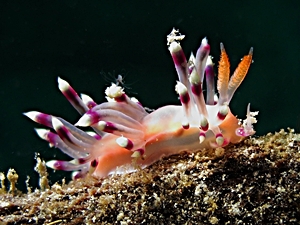 Flabellina exoptata (Aeolidia) from Malaysia. Picture: Choh Wah Ye. |
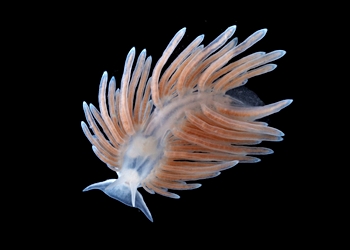 Nudibranch slug (Nudibranchia) Cuthona rolleri, Humboldt Ct., Califor- nia, USA. Picture: Sadie Hine (iNaturalist).  Enlarge image!
 |
Owing to their remarkable diversity of colours - which has made them popular photographic subjects among divers - these shell-less sea slugs have become so well known that one is often tempted to regard all marine slugs as nudibranchs.
True
Facts: Freaky Nudibranchs. Video von ZeFrank1 auf YouTube.
146
Nudibranchs and Sea Slugs of Anilao, Philippines. Video von Bart Adams auf
YouTube.
Marine Gastropods: Ecology and Habitats:
Nudibranch slugs (Nudibranchia).
This adorable sea slug as a sneaky little thief.
Video by Deep Look on YouTube.
However, this overlooks the fact that shell-less forms occur in several other groups of opisthobranchs as well. Among the headshield slugs (Cephalaspidea), for instance, the colourful family Aglajidae includes many such forms; among the "sea butterflies" (Pteropoda), the sea angels (Clionidae) are likewise shell-less; and numerous shell-less species also occur among the sap-sucking slugs (Sacoglossa). Even the Onchidiidae, which belong to the pulmonates (Pulmonata), could, with some justification, be regarded as marine slugs.
Nudibranchs themselves, however, may justifiably be described as the "most naked" of all marine slugs. Their mantle cavity is greatly reduced, and the primary gill is entirely absent. Respiration takes place either through the skin or via secondary gills, which are typically arranged in a tuft on the posterior part of the dorsum.
The dorsal appendages of nudibranchs are known as cerata (from Greek κερόϛ - "horn"). Extensions of the digestive gland extend into these cerata, so that they are connected not only with the circulatory system but also with the digestive system. The cerata also play an important role in the defensive strategies of nudibranchs.
Bill Rudman:
Cerata (ceras)
in aeolids on
seaslugforum.net.
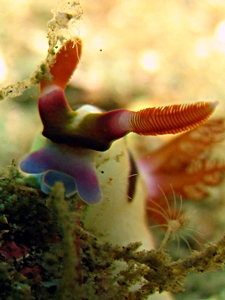 Head and rhinophores of Nembrotha purpu- reolineata. Picture: Choh Wah Ye. |
Video: "The
Lynx Nudibranch" (Phidiana lynceus). Source:
Coral Morphologic.
Also note the oyster's (Spondylus americanus) mantle eyes or ocelles!
Like all opisthobranchs, nudibranchs are hermaphrodites, and mating takes place reciprocally. The eggs are laid in long ribbons. From these, planktonic veliger larvae hatch, which eventually develop into juvenile slugs. While the veliger larvae still possess a small shell (the protoconch), this is completely reduced during later development.
Nudibranchs are generally carnivorous or feed on carrion, often showing a more or less pronounced degree of dietary specialisation. Some species feed on sponges, others on bryozoans, hydroids or jellyfish (Hydrozoa), tunicates (Tunicata), barnacles or sea anemones. Certain nudibranchs also prey on other marine slugs, including other nudibranchs, and may even consume smaller individuals of their own species.
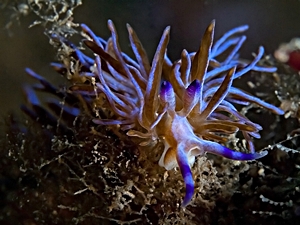 Pteraeolidia ianthina (Aeolidia) from Australia. Picture: Doug Anderson (Source). |
In some cases, nudibranchs probably acquire these zooxanthellae through their diet - for instance by feeding on jellyfish that already harbour them. In other cases, the origin of the zooxanthellae is still not fully understood. Unlike the retained chloroplasts in sacoglossans, however, the zooxanthellae in nudibranchs remain intact, fully functional cells.
Zooxanthellae also supply the bivalve giant clams (Tridacna) with photosynthetic products, and reef-building stony corals likewise harbour these symbionts. In principle, host organisms are able to survive without zooxanthellae; however, for reef-building corals these symbiotic algae are essential. Only with their assistance are corals able to obtain sufficient nutrients to build their calcareous skeletons - and thus the reef itself.
Bill Rudman:
Zooxanthellae in
nudibranchs on seaslugforum.net.
The Hooded Nudibranch (Melibe leonina)
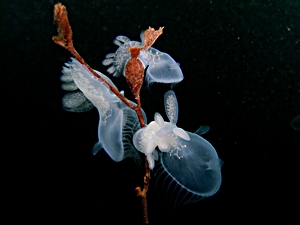 Hooded nudibranchs feeding on a kelp plant. Picture: Jackie Hildering (Source). |
The almost transparent animal, with its leaf-like dorsal appendages that serve as gills and are traversed by blood vessels, inhabits kelp forests. Here it crawls among the algae and is also capable of swimming by means of a characteristic twisting and undulating motion. During the mating season in late summer, these small slugs can often be seen in their thousands, clinging to the kelp plants.
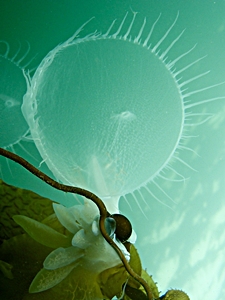 Hard to recognise as a gastropod: A hooded nudibranch (Melibe leonina) feeding on plank- ton. Picture: Jackie Hildering (Source). |
This ring of tentacles around the mouth likely reminded observers of a lion’s mane, hence the common name. Especially when swimming near the surface, hooded nudibranchs may easily be mistaken for jellyfish due to their unusual body shape.
The Lion's Mane Nudibranch Sea Slug, Melibe leonina.
Monterey
Bay Aquarium auf YouTube.
Melibe leonina feeds primarily on zooplankton, in particular small crustaceans living among the kelp, including amphipods, copepods and others, as well as smaller molluscs and, more rarely, even small fish. The animal first extends its hood over the prey and then closes it, while the marginal tentacles prevent the prey from escaping. At times, hooded nudibranchs also capture plankton from the open water by spreading their hood wide and extending the head into the surrounding water. Related species, such as Melibe mirifica from Indonesia, search the substrate for food in a manner reminiscent of a vacuum cleaner.
On the sides of the hood, the small, ear-shaped rhinophores can be seen in some individuals. Like most opisthobranchs, hooded nudibranchs have very poor eyesight and are able to distinguish only between light and dark. When searching for a mate, they therefore release a pheromone based on terpenoids, which has a fruity scent to the human nose.
This chemical signal serves not only to attract partners but also to deter predators. Hooded nudibranchs release it when disturbed and unable to escape by swimming away. Somewhat unusually for a nudibranch, this attractant and defensive compound is not derived from the animal’s diet, nor is it produced by modifying food-derived substances. Instead, it is synthesised independently by the nudibranch itself. Plants also employ Terpenoid compounds: when attacked by herbivores, they may release such substances to attract predators that feed on those herbivores.
Barsby,
T.; Linington, R. G.; Andersen,
R. J. (2002): "De Novo terpenoid biosynthesis by the dendronotid nudibranch
Melibe leonina". Chemoecology 12: 199 - 202.
Jörg Degenhardt
et al.:
Die Funktion von Terpenen bei der Verteidigung der Pflanze. AG
Pharmazeutische Biotechnologie, Halle-Wittenberg University. (Accessed:
23.04.26).
From a systematic point of view, the hooded nudibranchs and their relatives, the family Tethydidae, belong to the dendronotid nudibranchs (Dendronotida), named after their tree-like branched cerata.
Melibe
leonina on
Wikipedia.
Melibe (Melibe leonina) in Monterey Aquarium (Monterey,
California, USA).
Nudibranchs auf dem Blog "The
Marine Detective".
Melibe colemani from the Philippines. Facebook Reel by
Diver Bliss.
Without a protective shell or operculum, nudibranchs may at first appear almost defenceless in the ocean. However, this group has evolved a remarkable variety of defensive strategies, enabling them to survive successfully without such protection.
Much like sea hares and sacoglossans, many nudibranchs are able to sequester toxic substances from their prey and use them for their own defence. In particular, sponge-feeding species can incorporate the chemical compounds produced by their prey into their own tissues. Changes in diet may therefore be accompanied by changes in the composition of these toxins.
Some species, however, are capable of producing their own defensive chemicals, independent of their food. In certain cases, nudibranchs can even produce acidic substances to deter attackers.
Edmunds,
M. (1968): "Acid secretion in some species of Doridacea (Mollusca,
Nudibranchia)". Proceedings of the Malacological Society of London 38: 121 -
133.
Some marine slugs are also able to shed their dorsal appendages (cerata), much like a lizard shedding its tail. This can distract a predator long enough for the animal to escape.
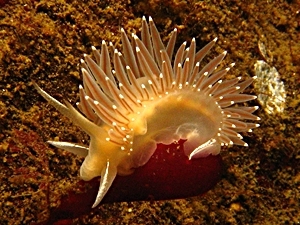 Flabellina trophina, northwestern US coast. Picture: Dan Hershman (Source). |
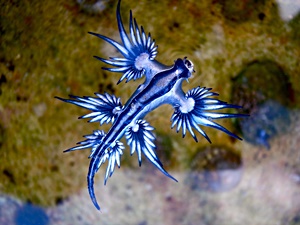 Blue sea dragon (Glaucus atlanticus) from Australia. Picture: Sylke Rohrlach.
Enlarge Picture! |
Remarkably, the slug is not only able to avoid injury from these stinging cells but can also render them harmless and store them within the extensions of the digestive gland (see above) in its cerata. There, the nematocysts are retained and later discharged when a predator attempts to bite the slug. Glaucus selectively accumulates the most potent stinging cells of its prey, so that the slug may ultimately become even more venomous than the cnidarian itself.
Glaucus atlanticus feeds not only on siphonophores such as the Portuguese man o' war (Physalia physalis), the by-the-wind sailor (Velella velella) and the blue button (Porpita porpita), but also on violet snails (Janthina janthina) and even on other of its own kind.
Bill Rudman:
Glaucus atlanticus auf seaslugforum.net.
Blue Sea
Dragon Facts: Animal Fact Files auf YouTube.
Interestingly, the blue sea dragon exhibits reversed colouration compared to most marine animals: its ventral side is dark, while the dorsal side is light. This is due to its unusual mode of swimming. A gas-filled float provides buoyancy but is located on the ventral side of the animal, causing it to drift upside down at the surface. In addition, Glaucus carries its cerata laterally rather than dorsally, giving it a highly distinctive appearance.
Among the nudibranchs, several species are capable of bioluminescence, meaning that certain organs or parts of the body can emit light. These include Plocamopherus imperialis, which produces light when disturbed, and Phylliroe bucephalum, a highly modified, planktonic nudibranch that lives on jellyfish
Bill Rudman:
Phylliroe
bucephalum on seaslugforum.net.
Bill Rudman:
Plocamopherus
imperialis on seaslugforum.net.
In the systematics according to Bouchet et al. (2005), together with a family of former side-gill slugs ('Notaspidea') form the clade Nudipleura. Also during this, the group of Notaspidea, following phylogenetic deliberations has been disbanded.
Latest Change: 23.04.2026 (Robert Nordsieck).