
| Diese Seite auf Deutsch! |
|
Bluering OctopusesHapalochlaena G. C. Robson, 1929 |
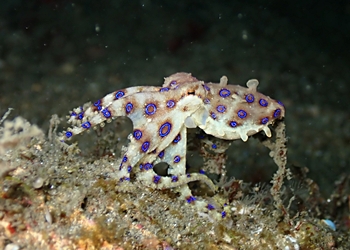 Large Bluering Octopus (Hapalochlaena lunulata): Bitung, Sulawesi, In- donesia. Photo: Eva Paulus (iNaturalist)  Enlarge!
 |
Octopuses (Octopodidae) have only eight arms covered in sucker cups. Hence their scientific name which means "eight-foot". Also, they lack all remainder of a shell, be et internal, as in cuttlefish (Sepiida) or squids (Myopsida), or external, as in a nautilus (Nautilida). What they lack in protection, most octopuses make up for in intelligence very highly developed for an invertebrate animal - actually octopuses are assumed to be the most intelligent of all invertebrates: The have an astonishing capability to solve problem, as has been shown in numerous experiments. The second success strategy to protect the presumably defenceless octopuses is their capability to change their colour and sometimes even their surface structure. In the end, there are even octopuses that are able to use inanimate objects to camouflage or protect themselves.
There is another, albeit offensive, strategy octopuses can apply: Venom. Octopuses mainly feed on crustaceans, the carapaces of which they crack open using their strong beak. They then inject a mixture of different substances into the prey's body, consisting of digestive enzymes to soften the prey's organs, but also paralyzing agents to immobilize it. Bluering octopuses, also referred to as blue-ringed octopuses, mainly to be found in an area around Australia, Indonesia, the Philippines and New Guinea, as far as Japan, have perfected this - with the help of symbiotic bacteria in their body.
|
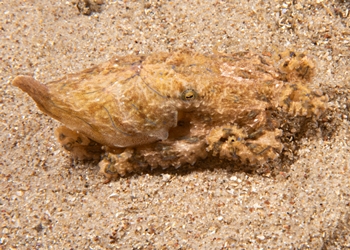 Blue Striped Octopus (Hapalochlaena fasciata) without warning pattern: Port Stephens, Nelson Bay, New South Wales, Australia. Photo: Eric Schlögl (iNaturalist)
Enlarge! |
|
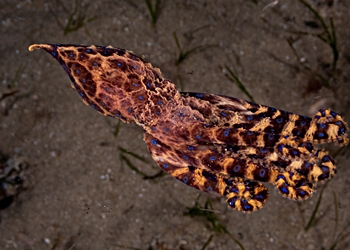 Southern Bluering Octopus (Hapalochlaena maculosa): Bay Trail, Rye, Victoria, Australia. Photo: Elodie Camprasse (iNaturalist)
Enlarge! |
|
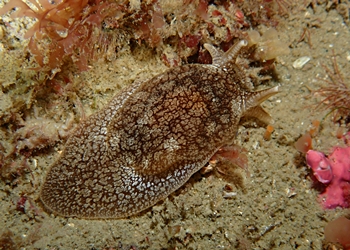 Notaspidean Sea Slug (Pleurobranchaea maculata): Rodney, Auckland, New Zealand. Photo: Gillian Houston (iNaturalist)
Enlarge! |
Bluering octopuses mainly live on coral and rocky reefs in a depth of up to 50 m, where they hunt different crustaceans and also other molluscs. The small octopuses hide in caves and crevasses in the rock and camouflage their hiding places with stones, shells and carapaces. Some species also can be found near the beach and during low tide hide in and under beach litter, as well as, often enough, also in cans and bottles lying around.
Though many bluering octopuses are rather shy creatures that would rather evade a human than attacking him, that is when an encounter between the two can often happen and when the colourful pattern, bluering octopuses derive their name from, appears to be a two-edged sword: While bluering octopuses usually display a rather inconspicuous yellowish or brown colour with a weakly coloured ring pattern, they change into their aposematic warning colour as soon as they feel threatened and cannot flee by withdrawing. So then, they display a bright yellow base colour and the about 50 to 60 rings on their body and arms change to radiant blue tones. Supported by so called iridophores (see Colour Change), by reflecting the incoming light, they produce an iridescent effect. Using muscles in their skin, the octopus can even have the rings move and flash, enhancing the warning effect.
 |
| Mäthger, L.M.; Bell, G.R.; Kuzirian, A.M.; Allen, J.J.; Hanlon, R.T. (2012): "How does the blue-ringed octopus (Hapalochlaena lunulata) flash its blue rings?". The Journal of Experimental Biology. 215 (21): 3752 - 3757. (Link). |
Though bluering octopuses are capable of producing ink, and especially juveniles often use ink as defense, in adult bluering octopuses the inc sac is stronly reduced and, if at all, almost never used.
Huffard,
C.; Caldwell, R.L. (2002): "Inking in a
Blue-Ringed Octopus, Hapalochlaena lunulata, with a Vestigial Ink Sac".
Pacific Science. (Link).
However, bluering octopuses can support their aposematic warning colour pattern with more effective defence measures, if necessary. While bluering octopuses, like other octopuses, use a mixture of different proteolytic digestive enzymes and paralyzing substances to subdue their prey, they have another means of defence that made them one of the best-known octopus groups: Venom. Except for defence, the venom is also used during hunting and in some species even during copulation.
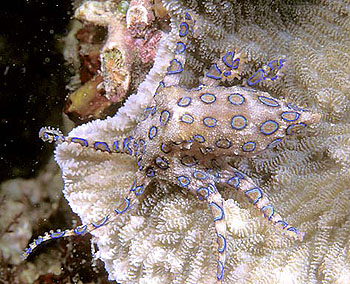 Large Bluering Octopus (Hapalochlaena lunulata): Anilao, Philippines. Photo: Jeff Rosenfeld. Source: Vibrant Sea. |
|
|
Do Bluering Octopuses Poison Themselves? Bluering octopuses do not poison themselves, since the sodium ion channels in their neurons are less sensitive to the venom. If a male Blue Striped Octopus (H. fasciata) wants to stop a female from attacking him during mating, he has to bite her with a high dose into a vital organ. |
| |
| Williams, B.L.; Hanifin, C.D.; Brodie, E.D.; Caldwell, R.L. (2012): "Ontogeny of tetrodotoxin levels in blue-ringed octopuses: Maternal investment and apparent independent production in offspring of Hapalochlaena lunulata". In: Journal of Chemical Ecology 37, Nr. 1, 2011, S. 10 - 17. (Abstract). |
Bluering octopuses contain tetrodotoxin in variable concentrations in all organs and body parts, the highest being found in the salivary glands. Experiments in Japan only little time ago have found that the octopus does not exclusively transfer the venom by biting its target, however that is the most frequent way. Blue Striped Octopuses (Hapalochlaena fasciata), in a controlled manner, can accumulate venom in defined parts of their bodies, as soon as they perceive a threat my olfactory of optical means. In the experiment, the octopus was exposed to a morey eel, but separated from it by a plexiglass wall. As a consequence, the tetrodotoxin concentration measurably increased, epecially in the octopuses' mantle and slime.
The experiment also was able to show that bluering octopuses can release tetrodotoxin together with slime from their body surface. How the poison is moved from the skin and musculature into the slime, so far is unknown. Equally unknown is how the octopus manages to move tetrodotoxin though its body, though the venom is not produced by the octopuses' organism itself.
| |
| Science Japan: Nagasaki University discovers that Japanese blue-lined octopus releases venom from skin in the presence of predators. |
| |
| Yamate, Y.; Takatani, T.; Takegaki, T. (2021): "Levels and distribution of tetrodotoxin in the blue-lined octopus (Hapalochlaena fasciata) in Japan, with special reference to within-body allocation". Journal of Molluscan Studies. 87 (1). (Abstract). |
| |
| Yamate, Y.; Takatani, T.; Takegaki, T. (2025): "Verification of tetrodotoxin utilisation against predators in Japanese blue-lined octopus Hapalochlaena cf. fasciata". Molluscan Research, 45 (1), 1 - 8. (Abstract). |
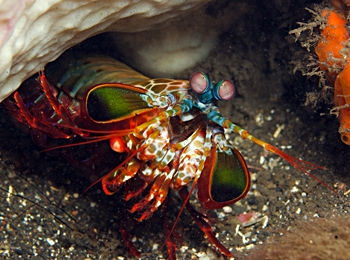 Clown Mantis Shrimp (Odontodactylus scyllarus): Northwestern Bali, Indonesia. Photo: Laura Cook (iNaturalist). |
Mantis Shrimps and Bluering Octopuses Tetrodotoxin, used by bluering octopuses and several other animal species, is one of the most potent neurotoxins known to us. It blocks the sodium ion channels in the neurons and thus paralyzes respiration. Only few animals in their habitat can become dangerous to a bluering octopus with its conspicuous warning colour. Among the few predators of bluering octopuses, however, are mantis shrimps (Stomatopoda, e.g. Odontodactylus scyllarus). Those can kill a bluering octopus using their signature lightning claw strike fast enough, the octopus is dead before it can use its venom. Also, presumably those mantis shrimps are less susceptible to bluering octopus venom, otherwise they would not be able to eat them, without poisoning themselves.
Roy L. Caldwell:
Peacock
Mantis Shrimp kills Blue-ringed Octopus. |
This could be described as a form of mimicry, though those octopuses still are quite venomous. As a consequence, there are only few animals that could prevail against a bluering occtopus. Among those, there are mantis shrimps (Stomatopoda) and at least occasionally also other bluering octopuses. Since the females are noticeably larger than the males, those during mating sometimes have to rely on unusual measures to ensure their own survival and a successful mating procedure.
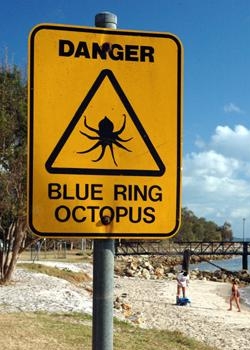 The classical Australian sign warning of Bluering Octopuses. Photo: OceanRealmImages (Source). |
Bluering octopuses also, as already mentioned, are rather shy, and little
territorial creatures. If during an encounter a bluering octopus displays its
warning colour pattern, thus showing that it feels threatened or irritated,
there usually is more than enough time to withdraw, as compared to encountering
a cone snail, for example.
Awareness and caution, in this case, can prove lifesaving. It is especially
wise to refrain from intentionally angering a bluering octopus to provoke the
beautiful colour pattern for a photo.
Healthline:
What to Do If You’re Bitten by a Venomous Blue-Ringed Octopus.
St. John West Australia:
How to treat blue ringed octopus and cone shell bites.
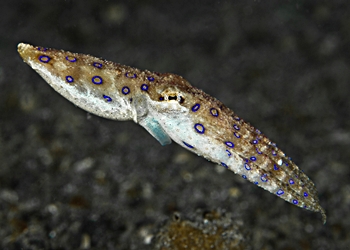 Larger Bluering Octopus (Hapalochlaena lunulata): Bitung, Sulawesi, Indonesia. Photo: Steve Cappell (iNaturalist)
Enlarge! |
|
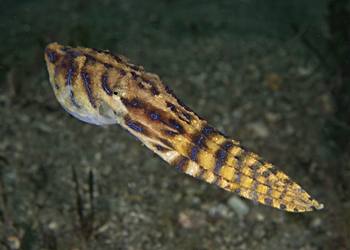 Blue Striped Octopus (Hapalochlaena fasciata): Port Stephens, New South Wales, Australia. Photo: Steve Smith (iNaturalist)
Enlarge! |
Similar to other cephalopods, bluering octopuses often move short distances by using their typical water jet propulsion, squirting water from the mantle cavity through the siphon (see pictures left). Also similar to other octopuses, they can move slowly by "crawling" over the sea floor using their arms.
Mating begins with a mating prelude, during which the male mounts the female and strokes her with his hectocotylus. Afterwards he tries to insert the hectocotylus into her mantle cavity. If he is successful, he begins placing spermatophores in her mantle cavity.
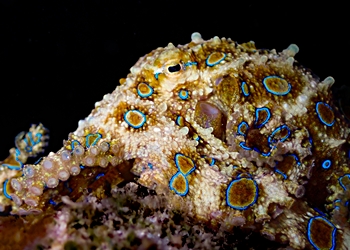 Large Bluering Octopus (Hapalochlaena lunulata): Logon, Cebu, Philip- pines. Photo: Lou van Haeren (iNaturalist)
Enlarge! |
Blue Striped Octopuses (Hapalochlaena fasciata) also use their venom during mating: The female is larger than the male and a failed attempt to mate might well end with her killing and eating the male. Thus, he bites her, so she is paralyzed during the mating procedure. To do so, however, he has to apply a highly dosed bite at a vital place, such as the main aorta, since bluering octopuses are almost immune against their own venom (see box above). The venom stops working after a certain period of time and the female has no negative consequences afterwards.
Apart from that, mating attempts have also been observed between two males. The mating male, however, soon withdraws, after recognizing his error and there also is no complete mating, since no spermatophore is transferred.
| |
| Aquarium of the Pacific: Greater Blue Ringed Octopus (Hapalochlaena lunulata). |
| |
| Cheng, M.W.; Caldwell, R.L. (2000): "Sex identification and mating in the blue-ringed octopus, Hapalochlaena lunulata". Animal Behaviour. 60 (1): 27 – 33. (Abstract). |
| |
| Morse, P.; Zenger, K.R.; McCormick, M.I.; Meekan, M.G.; Huffard, C.L. (2015): "Nocturnal mating behaviour and dynamic male investment of copulation time in the southern blue-ringed octopus, Hapalochlaena maculosa (Cephalopoda: Octopodidae)" (PDF). Behaviour. 152 (14): 1883 - 1910. (Abstract). |
| |
| Wen-Sung Chung (OctoNation): Blue Lined Octopus Mating Explained: Why Males Inject Venom During Sex. |
Afterwards, female bluering octopuses, once in their short life, usually in autumn, lay an egg batch of about 50 eggs. Afterwards she protects the eggs for about six months during which time she does not feed. As soon as the juveniles have hatched as paralarvae, the mother dies. The juveniles will be adults within the next year.
Roy L. Caldwell:
H.
lunulata hatching. ( YouTube Video).
 Large Bluering Octopus (Hapalochlaena lunulata): Anilao, Philippines. Photo: Jeff Rosenfeld. Source: Vibrant Sea. |
When it is calm, the Large Bluering Octopus appears in a light brownish to dark yellowish, even grey colour. About 50 weak blue rings, about 8 cm in diameter, cover the mantle and the arms. Each ring has a blackish rim and a dark brown central field. When the octopus changes to its warning colour, the weak blue ring change to a glowing iridescent blue colour and the body colour changes to a brighter yellow hue. Skin papillae give the octopus a rough body surface structure.
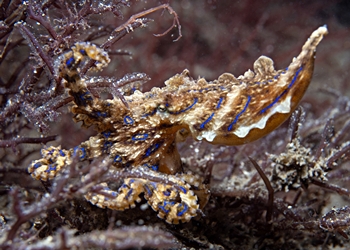 Blue Striped Octopus (Hapalochlaena fasciata): Port Stephens, New South Wales, Australia. Photo: Dave Harasti (iNaturalist)
Enlarge! |
This species' distribution area mainly covers the subtropical waters of eastern Australia, however the Blue Striped Octopus today also is found on the western and northern coast of Honshu and Kyushu in Japan. The Blue Striped Octopus lives on rocky reefs and coasts and can also be encountered in tidal pools during low tide.
| |
| Kim, J.H.; Suzuki, T.; Shim, K.B.; Oh, E.-G. (2012): "The Widespread Distribution of the Venomous and Poisonous Blue-lined Octopus Hapalochlaena spp., in the East/Japan Sea: Possible Effects of Sea Warming". Fisheries and aquatic sciences. 15. 1-8. (Link). |
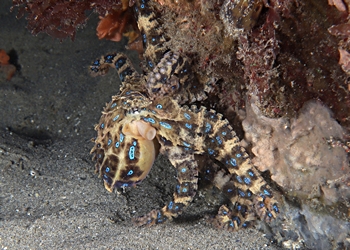 Southern Bluering Octopus (Hapalochlaena maculosa): Blairgowrie, Victoria, Australia. Photo: Tiffany Kosch (iNaturalist)
Enlarge! |
The Southern Octopus is described as a shy and harmless octopus species that will rather flee if given the opportunity than to defend itself. The animals are nocturnal and during the day they hide in caves and crevasses in the rockface, as well as in and under beach litter, such as in cans and bottles lying on the beach.
This species can grow to be the largest of alle bluering octopuses with a length of up to 22 cm, which potentially makes it noticeably larger than other species of the genus.
This species of bluering octopuses has hardly ever been described: The first time it was found in 1938 near the Andaman Islands, the second in 2013 from the Bengal Bay in southeastern India. Later further specimens were found in the Bengal Bay. Little is known about this species and it also does not have a valid vernacular name.
| |
| Sethi, S.N.; Nivas, R.K.; Sethi, S. (2019): "New records of blue ring octopus, Hapalochlaena nierstraszi, Adam 1938, from the Bay of Bengal along the Chennai coast, Tamil Nadu, India". Indian Journal of Geo-Marine Sciences. 48. 93-95. (Abstract). |
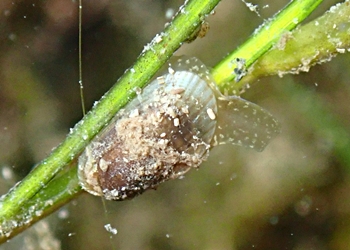 Asian Date Mussel (Arcuatula senhousia): Marennes, Charente Mariti- me, France. Photo: Frédéric André (iNaturalist). |
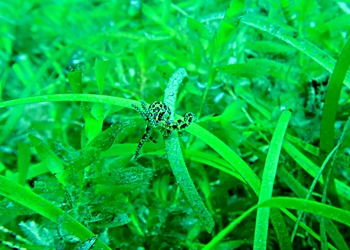 Southern Octopus (Hapalochlaena maculosa) in a sea grass meadow: Rapid Bay, Yankalilla, S. Australia. Photo: David Muirhead (iNaturalist).
Enlarge! |
In the ecosystems they live in, bluering octopuses are important, because they regulate the crustacean populations, and thus they also are an important part of the ecological equilibrium. Several species of bluering octopuses are important in regulating the numbers of Asian Date Mussels (Arcuatula senhousia, see picture left), an invasive species, which has strongly expanded to other areas from the Indian Ocean and today is even found in Europe. Like the common mussel, it is part of the Mytilidae family, also known as the blue mussels.
Additionally, bluering octopus might prove quite useful for medicine, since tetrodotoxin is researched as a pain medication, as well as in neurological research.
Presently, not conservation or protection programmes are known. It should, however, be mentioned, that many bluering octopus populations are vulnerable, since they are isolated by geographical borders, the octopuses cannot cross, such as deep water areas. There is also the growing problem of destruction of reefs due to human and ecological factors.
Finally, bluering octopuses are actually caught to be kept in aquariums, in spite of the danger they posse to handlers and their low life expectancy. But their pretty colour pattern, as well as the fact they almost never use ink, at least as adults, proved to be quite a persuasive argument.
YouTube Video).
YouTube Video).
YouTube Video).
Latest Change:
01.07.2026 (Robert
Nordsieck).
Latest Link Check: 24.05.2026.
