
| Diese Seite auf Deutsch! |
|
The Quagga MusselDreissena bugensis Andrusov 1897 |
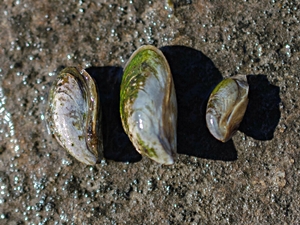
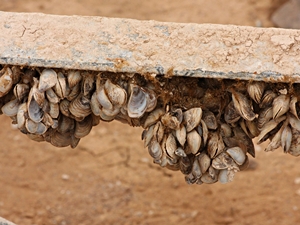 Quagga Mussels (Dreissena bugensis) in Nevada, USA. Photo: James N. Stuart (iNaturalist). |
The Quagga Mussel is a freshwater mussel originated from the Black Sea region, which has spread out vehemently in recent decades as an invasive species throughout Europe and North America. It is closely related to the notorious Zebra Mussel (Dreissena polymorpha); however it is different from the latter by a more rounded shell shape and the absence of a pronounced keel.
 MolluscaBase eds.
(2025):
Dreissena bugensis Andrusov, 1897.
MolluscaBase eds.
(2025):
Dreissena bugensis Andrusov, 1897.
Naturportal Südwest:
Dreissena rostriformis bugensis (Andrusov,
1897): Quagga-Dreikantmuschel (In German).
Wikipedia:
Quagga
Mussel.
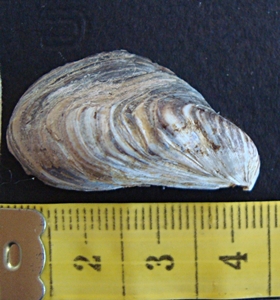 Quagga Mussel (Dreissena bugensis): Danube Island, Vienna. Photo: Jasmin Rehrmbacher (iNaturalist). |
The planktonic larvae drift freely in the water, enabling a rapid distribution over rather far distances.
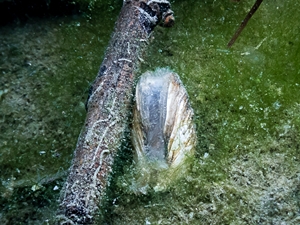 Quagga Mussel (Dreissena bugensis): Floridsdorf, Vienna. Photo: Oliver Drescher (iNaturalist). |
In Europe it has been documented in numerous countries since the 2010s, among them Germany, Austria, Bulgaria, France, Romania, Hungary and the Netherlands.
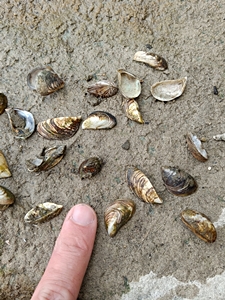
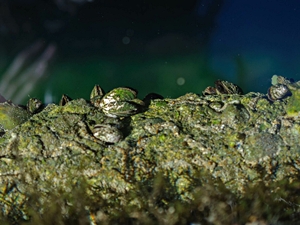 Quagga Mussels (Dreissena bugensis): Neuchâtel, Switzer- land. |
 Photos: Nicolas Schwab (iNaturalist). |
YouTube:
BR quer:
Umweltkatastrophe? Quagga-Muschel krempelt Bodensee um
(In German).
In Switzerland, the Quagga Mussel first was proven to be present in the River Rhine near Basel in 2014 or 2015. Since then, it has been spreading continuously, even replacing the formerly introduced Zebra Mussel. Especially affected are the large lakes in the Alpine Foothills, such as the Lake Geneve, the Biel Lake, Neuenburg Lake, Murten Lake and since 2024 also the Zurich Lake. A main problem is the lack in regulations concerning the import of foreign boats. Albeit Switzerland is not a large country, there are no country-wide regulations to that effect, thus enabling the further spreading of the species.
 Quagga Mussels (Dreissena bugensis). |
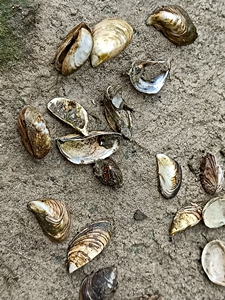 Linz, Upper Austria. |
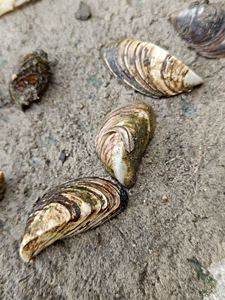 Photos: Kaulquappe (iNaturalist). |
Lakes:
Flowing Waters:
The first finding took place in the Attersee Lake and the Traun River in 2022, however genetic research has uncovered that the settlement could have taken place as early as since 2020. In June of 2023 an eDNA monitoring was undertaken in 23 lakes, which confirmed the findings that had so far been known. In further lakes such as the Wolfgangsee, Almsee, Hallstättersee, Gosausee or Irrsee, the species was proven genetically, but so far does not seem to have established itself durably.
Land
Oberösterreich:
Ausbreitung der gebietsfremden Quagga-Muschel in Oberösterreichs Seen verhindern
(In German).
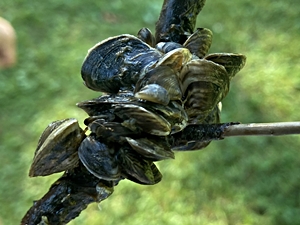 Quagga Mussels (Dreissena bugensis): Ossiach, Carinthia. Photo: Irene Girandoli (iNaturalist). |
Especially worrying is the ability of this species to spread out to settle deeper areas of water bodies. Studies in Lake Constance have shown that the species' biomass could increase to up to twenty times the current size until 2045. A similar timeline like in Lake Michigan (USA), where the species already makes 90% of the lake's entire biomass, are possible.
Great Lakes Now:
Quadrillions of Mussels Are Invading the Great Lakes. ( YouTube Video).
Great Lakes Now:
Invaders
on the Menu. (
YouTube Video).
YouTube Video).
Great Lakes Now:
Invaders
on the Menu. (
YouTube Video).
To prevent a further spreading of the species, following preventive measures might be decisive:
Especially important is a federal or even European rulebook for the transfer of boats and equipment, a point that has, for example, proven problematic in Switzerland.
Latest Change: 07.08.2026 (Robert Nordsieck).
